DATE
Loading...
TIME
Loading...
About Us

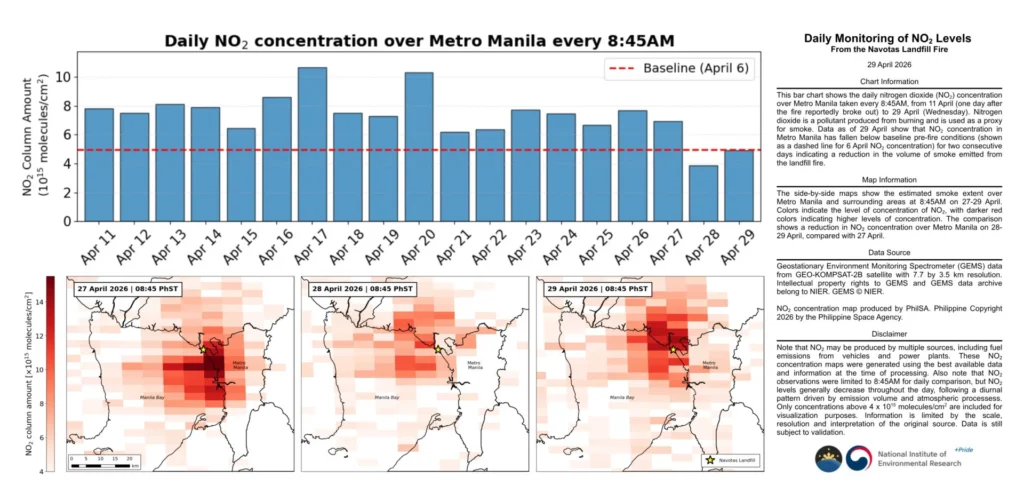
Satellite-based monitoring by the Philippine Space Agency shows that nitrogen dioxide (NO₂) levels across Metro Manila have dropped back to, and even below, pre-fire levels for two straight days, signaling improving air quality following the Navotas landfill fire.
PhilSA said it has been conducting daily satellite observations since the fire reportedly broke out on April 10. Data as of April 28 and 29 indicate NO₂ concentrations fell below April 6 baseline levels, aligning with field reports that fire suppression efforts have made significant progress.
NO₂ is a key pollutant produced by combustion and is a major component of smoke. Lower concentrations typically indicate reduced emissions from fire activity. The satellite findings were also consistent with ground measurements from the Environmental Management Bureau in the National Capital Region and Central Luzon, which recorded improved particulate matter (PM) levels over the same period.
PhilSA’s analysis included side-by-side satellite maps showing estimated smoke extent over Metro Manila at 8:45 a.m. from April 27 to 29. The data showed a visible reduction in NO₂ concentrations, with fewer high-intensity zones compared to earlier days. A time-lapse sequence covering April 11 to 29 further supports the downward trend in emissions.
The agency noted that NO₂ readings were standardized at 8:45 a.m. for daily comparison, as levels fluctuate throughout the day due to emission cycles and atmospheric processes. Aside from fire-related emissions, NO₂ may also come from vehicles, power plants, and other urban sources.
Beyond air quality, PhilSA is also tracking the extent of burned areas at the landfill using near-infrared satellite imagery from Sentinel-2C. Based on imagery captured on April 26, the burned area was estimated at 31.95 hectares, or around 319,500 square meters.
Comparative analysis with earlier data from April 16 showed a mixed trend: a slight reduction of about 0.89 hectares in the southern section of the landfill, but an increase of approximately 3.10 hectares in the eastern portion. PhilSA clarified that the satellite-based mapping identifies areas already burned and does not detect actively burning zones.
The agency has shared its analysis with the National Disaster Risk Reduction and Management Council to support response planning.
PhilSA said continued satellite monitoring will remain in place until conditions fully stabilize, with data intended to help authorities assess the effectiveness of ground interventions and guide further action.
Authorities continue to advise the public to follow updates from health agencies as air quality conditions evolve.