DATE
Loading...
TIME
Loading...
About Us

Filipino engineers are undergoing hands-on rocket training in South Korea as preparations move forward for the Philippines’ first liquid-fueled sounding rocket launch from local soil in Cagayan in 2027.
The Philippine Space Agency (PhilSA) said a 10-member team is undergoing training from August to October 2026 on the development, assembly, testing, and operation of a liquid-fueled rocket ahead of its planned launch in Lal-lo, Cagayan next year.
READ:
Philippines sets first liquid-fueled sounding rocket launch for 2027
The training marks the latest step in preparations for the historic 2027 launch, following its announcement during President Ferdinand Marcos Jr.’s fifth State of the Nation Address.
The program is being conducted with South Korean space mobility company Perigee Aerospace, Inc. under PhilSA’s SIKLAB, or Building Industrial Space Launch Systems Project.
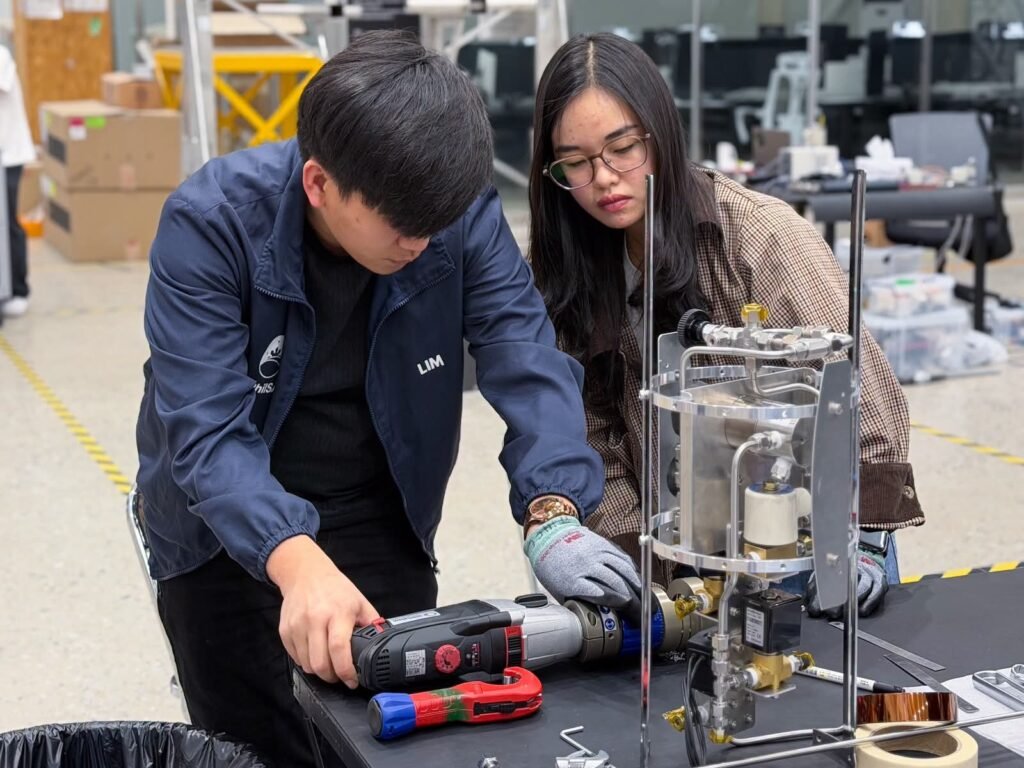
PhilSA personnel are gaining hands-on experience in rocket assembly, systems integration, testing, operational procedures, safety protocols, and preparations for the planned test launch.
“Progressively developing our domestic launch capabilities will allow greater flexibility and independence in sending satellites into space, which serves the country’s key sectors such as security, telecommunications, and agriculture,” PhilSA Acting Director General Gay Jane P. Perez said.
The current training builds on the first phase conducted in 2025 and expands the program to cover a broader range of activities in the liquid-fueled rocket operational cycle.
It uses Perigee’s Blue Whale 0.1, or BW0.1, a liquid-propellant sounding rocket platform. The training covers full-system assembly, integration, and testing in South Korea before preparations shift to launch operations in Cagayan.
The rocket assembled by the PhilSA team during the training will be shipped to the Philippines and undergo further testing ahead of the 2027 launch.
It is expected to carry a locally developed payload weighing around two kilograms to an altitude of at least five kilometers.
The payload, developed by PhilSA, will serve as a technology demonstration for a future suborbital or satellite-based platform capable of detecting and monitoring radio signals from ground-based sources.
PhilSA said the technology will measure and record signal strength, including signals transmitted by 4G LTE cell towers, and could eventually help identify areas with weak cellular coverage.
Launching the payload aboard the sounding rocket will allow engineers to test its functionality in a relevant flight environment and further advance its technology readiness.
“A successful liquid-fueled sounding rocket test launch in 2027 will demonstrate that we have the technical, operational, safety, and regulatory foundations for future launches from the Philippines; and potentially attract foreign investments from private aerospace companies,” Perez said.
PhilSA and the Cagayan Economic Zone Authority (CEZA) will also conduct local site preparations and dialogues with the local government and communities in Cagayan.
A safety exclusion zone plan is being developed to ensure the safety of nearby areas throughout the different stages of the launch activity.
As TechWatch PH reported in July, the planned demonstration flight is part of a broader government effort to develop the country’s domestic launch capabilities and lay the groundwork for future launch activities in the Philippines.
Marcos identified Cagayan during his 2026 SONA as “geographically and economically primed” to serve as the country’s gateway to space.
The Cagayan North International Airport will provide existing infrastructure to support the launch activity, complemented by the institutional and economic zone framework administered by CEZA.
The Department of Information and Communications Technology (DICT) and Ascend International Gateway, a Philippine company engaged in airport operations and management, are providing connectivity and logistical support.
PhilSA’s cooperation with Perigee dates back to 2022 and includes technology transfer and training aimed at developing Filipino expertise in rocket systems and launch operations.
“Beyond the test launch, SIKLAB is a long-term investment in Filipino talent and innovation. Through collaboration among government, industry, and international partners, PhilSA is building technical competencies and operational experience while contributing to a broader vision: a Philippine space ecosystem where the next generation of Filipino scientists, engineers, business, and support professionals don’t have to leave, because they can develop their expertise and pursue high-value careers as part of the country’s growing space sector,” Perez said.
PhilSA said the project is also expected to generate technical and operational knowledge relevant to future spaceport development, industrial partnerships, and regional cooperation as the country strengthens its capabilities for future launch activities.