About Us

DECODED: TECH, TRUTH, AND THREATS
For the past few weeks, I have been quietly warning friends and contacts in Mindanao about a growing pattern I have been seeing on Facebook.
The pitch is familiar. A friend or relative invites you to “invest” in Riscoin. The returns are framed as fast, daily, and almost effortless. The real hook comes next. You earn more if you recruit others. Bring in family. Bring in close friends. Build a network and the money supposedly flows faster.
In my case, I was even invited to join by someone I personally knew. That is how these schemes gain traction. They do not arrive as cold calls. They come wrapped in familiarity and trust.
To entice new investors, recruiters often flash supposed signs of wealth online. Photos of cash laid out on tables. Videos of houses being constructed or renovated. Screenshots of digital wallets, withdrawal confirmations, luxury purchases, travel, and claims of financial freedom achieved in just weeks. These posts are carefully curated to project success and urgency, creating the illusion that everyone else is already profiting.
This is not happening in private corners of the internet. It is happening openly, peer-to-peer, inside trusted social circles. That is what makes it dangerous.
As a co-founder of Scam Watch Pilipinas, it is my responsibility to warn others when all the classic red flags are present. In this case, they are hard to miss. The promise of easy money. Daily guaranteed returns. A strong push to recruit others to earn faster. These are the same indicators we see repeatedly in investment scams that eventually collapse, leaving ordinary people to absorb the losses.
This week, the Securities and Exchange Commission confirmed what many of us in the tech and cybersecurity community already suspected.
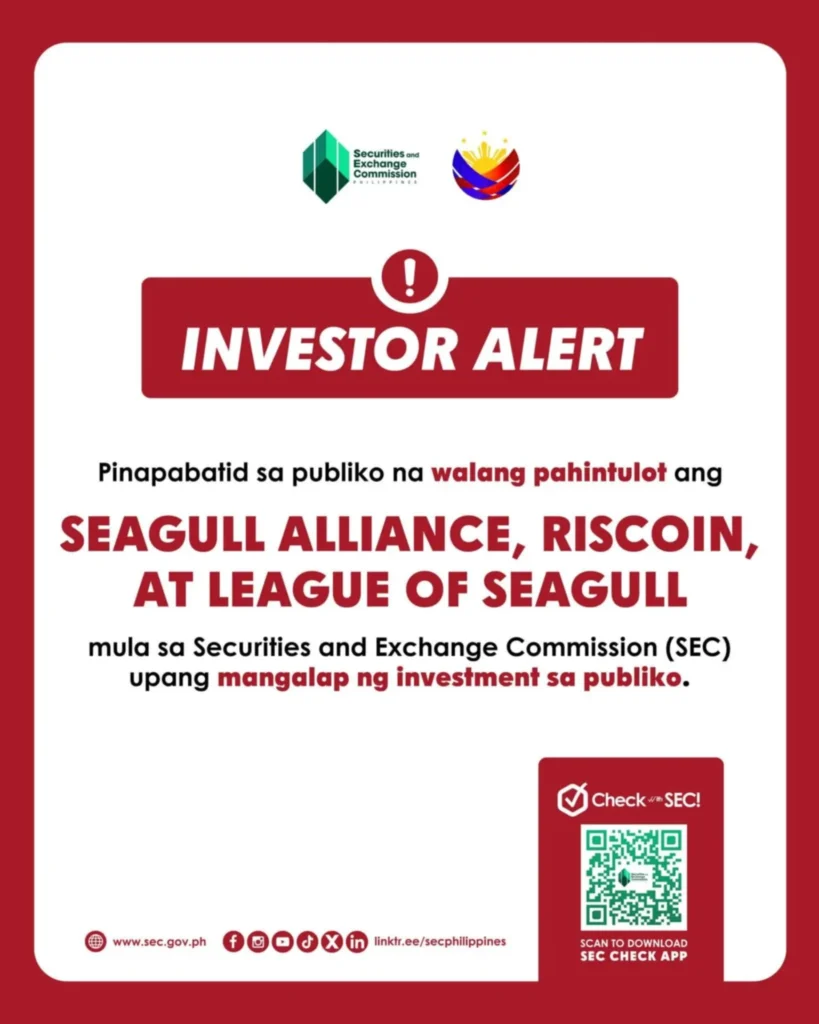
In a formal advisory issued by the SEC Zamboanga Extension Office, the Commission warned the public that Seagull Alliance, often associated with “Riscoin” or “League of Seagull,” is not authorized to solicit investments in the Philippines .
The advisory is explicit.
“Certain individuals or groups are soliciting investments on behalf of an entity known as SEAGULL ALLIANCE, often associated with names such as ‘RISCOIN’ or ‘LEAGUE OF SEAGULL,’ through the social media platform Facebook and messaging applications such as Telegram” .
The SEC goes further, describing how the scheme works. Users are encouraged to install mobile configuration profiles linked to Riscoin, allowed to withdraw small amounts at first to build trust, and later told their funds are “locked.” Victims are then asked to deposit more money labeled as “verification” or “risk” fees to regain access .
This is not innovation. This is textbook manipulation.
According to the SEC, the operation promises 1 percent to 4 percent daily interest, compounded, with a minimum investment of around PHP 30,000. The Commission states clearly that this arrangement constitutes an investment contract, falls under the Securities Regulation Code, and is not registered nor licensed .
More importantly, the advisory does not mince words about the structure.
“The investment scheme exhibits the characteristics of a Ponzi Scheme, wherein funds from new investors are used to pay purported profits to earlier investors” .
That sentence alone should stop anyone from clicking an invite link.
What worries me most is not just the scheme itself, but how it spreads. Recruitment is not done by strangers. It is done by people you trust. Old classmates. Church friends. Relatives. That social pressure lowers defenses faster than any slick marketing campaign ever could.
This is why I have been speaking up, especially in Mindanao, where community ties are strong and online financial literacy gaps are still being exploited.
The SEC has already warned that those who recruit, solicit, or act as agents may face criminal liability, with penalties reaching up to PHP 5 million in fines and up to 21 years of imprisonment .
That is not a theoretical risk. That is the law.
If someone approaches you about Riscoin, Seagull Alliance, or any similar copy-trading or referral-driven crypto scheme, the safest response is simple. Stop. Verify. Walk away.
Fast money stories collapse quickly. The damage they leave behind lasts much longer, especially when it fractures families and friendships in the process.
Staying silent only helps these schemes grow. Speaking up is the first line of defense.