How BetterGov.PH used technology to trace nearly ₱190B in 2027 budget additions
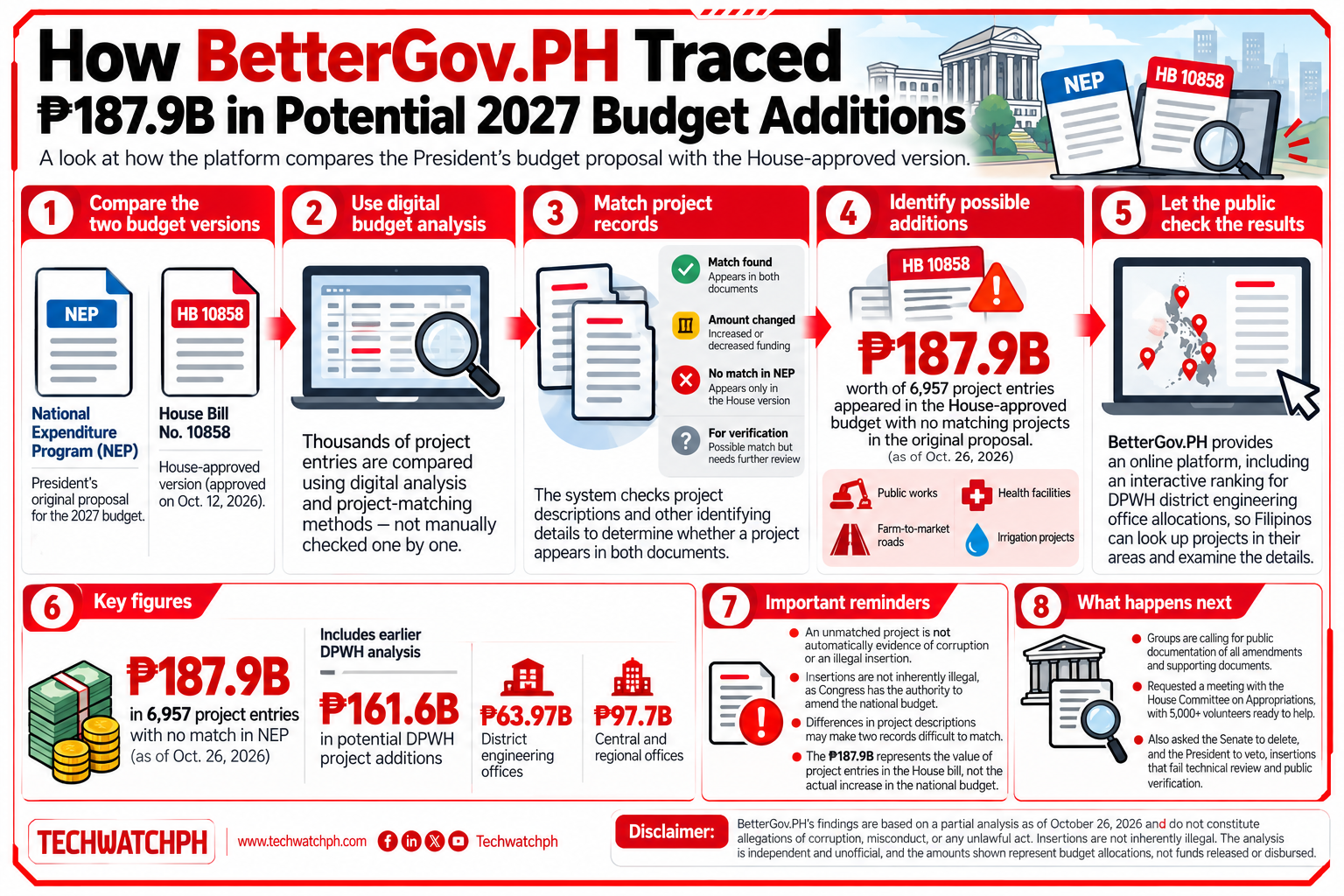
Instead of manually examining thousands of project entries one by one, BetterGov.PH used digital budget analysis and project-matching methods to identify corresponding records across the two budget versions. The process examines project descriptions and other identifying details to determine whether an infrastructure project appears in both documents.
-
TechWatch PH
Civic technology group BetterGov.PH is making that comparison easier through an online platform that allows the public to examine changes in the proposed 2027 national budget.
In its latest findings released with the People's Budget Coalition on October 30, BetterGov.PH reported that 6,957 project entries worth ₱187.9 billion in the House-approved budget had no matching projects in the President's original spending proposal.
The findings, based on a partial analysis as of October 26, cover public works, farm-to-market roads, health facilities, and irrigation projects.
However, the groups emphasized that an unmatched project is not automatically evidence of corruption or an illegal insertion.
The groups clarified that budget insertions are not inherently illegal, as Congress has the authority to amend the proposed national budget. However, they called for supporting documents and public verification of the amendments to ensure transparency and accountability.
But how did BetterGov.PH arrive at these figures?
The group compared two documents: the National Expenditure Program (NEP), which contains the President's proposed budget, and House Bill No. 10858, the proposed 2027 General Appropriations Bill approved by the House of Representatives on October 12.
Instead of manually examining thousands of project entries one by one, BetterGov.PH used digital budget analysis and project-matching methods to identify corresponding records across the two budget versions.
The process examines project descriptions and other identifying details to determine whether an infrastructure project appears in both documents.
It also distinguishes projects with increased or reduced funding from those appearing only in the House-approved version.
In simpler terms, the technology helps answer one question: Was this project already in the original budget, or did it appear in the version approved by the House?
However, an unmatched entry is not automatically proof of a new insertion. Differences in project descriptions or other details can make two records difficult to match, which is why the results remain subject to verification.
In the October 30 findings, the groups disclosed that ₱10.5 billion of the ₱187.9 billion involved project matches are still being verified.
They also acknowledged that some apparent insertions may turn out to be projects already included in the NEP but renamed or relocated in the House-approved version.
For the earlier DPWH-specific analysis, BetterGov.PH identified ₱161.6 billion in potential project additions. Of this amount, ₱63.97 billion was linked to DPWH district engineering offices, while another ₱97.7 billion fell under central and regional offices.
The group presented the district engineering office allocations through an interactive online ranking, allowing Filipinos to look up congressional districts and examine the amounts associated with offices serving their communities.
For residents wondering how infrastructure funding in their areas has changed, the platform provides a starting point without requiring them to sift through lengthy government budget documents.
However, BetterGov.PH stressed that the amounts belong to DPWH offices, not individual lawmakers. Some engineering offices serve multiple districts, meaning the same allocation may appear alongside more than one representative.
“These are insertion candidates, House Bill 10858 (third reading) projects with no matching line in the 2027 NEP. They come from comparing the two published documents. They are not findings of wrongdoing by any office or official. Amounts belong to the DPWH office that serves each district, not to representatives. The documents do not say who asked for any project. An office shared by several districts is shown whole for each, not split. Independent analysis, not an official government record,” BetterGov.PH Founder Jason Torres said.
The groups also clarified that the nearly ₱190 billion represents the value of project entries appearing only in the House bill, not the actual increase in the national budget.
To explain the difference, BetterGov.PH presented a hypothetical office with a ₱629-million allocation in the original NEP.
If ₱750 million worth of new projects were added but ₱480 million worth of existing projects were removed, the office's allocation would increase to ₱899 million.
In that example, the actual budget increase would be only ₱270 million, rather than the ₱750 million worth of new entries.
The distinction matters because identifying projects that appear only in the House-approved budget does not necessarily mean that the government increased spending by an equivalent amount.
Beyond identifying differences between budget versions, BetterGov.PH and the People's Budget Coalition want the government to explain the changes and make supporting documents publicly accessible.
“We at BetterGov demand public documentation of the projects that have been inserted and adjusted,” BetterGov.PH said.
In their October 30 statement, the groups called on the House Committee on Appropriations to publish every amendment to the President's budget, including its origin and justification, along with the supporting documents behind each project.
They also requested a meeting with the committee, saying more than 5,000 civic technology volunteers were ready to help establish public verification before the 2027 budget is passed.
Among the documents the groups identified as necessary for verification were programs of works and cost estimates, geotagged photographs and locations, feasibility studies or engineering designs, certificates of implementability, Local Development Council endorsements, and field validation reports for farm-to-market roads.
The groups clarified that describing a project as unsupported means they found no publicly available documents to verify it, not that the documents necessarily do not exist.
They said projects could be reclassified as supported amendments once the relevant documents are made public.
The groups also called on the Senate to delete, and the President to veto, insertions that fail technical review and public verification.
The findings come amid scrutiny of infrastructure allocations in the proposed ₱7.2-trillion national budget for 2027.
On October 26, Senate Committee on Finance Chairperson JV Ejercito disclosed that approximately ₱266 billion worth of DPWH infrastructure projects had been flagged for further examination.
The Senate also found that only 1,418 of the 16,244 projects in the House-approved DPWH operations budget had supporting documents submitted to the committee at the time of its review.
For BetterGov.PH and the People's Budget Coalition, making the underlying budget records accessible provides an opportunity for Filipinos to examine proposed public spending and seek explanations for changes before the national budget is finalized. Disclaimer In its FY2027 Budget Workbenches disclaimer, last updated October 26, BetterGov.PH emphasized that its findings do not constitute allegations of corruption, misconduct, or any unlawful act by a person or office.
The group reiterated that Congress may amend the national budget and that an insertion is not inherently illegal.
Displaying a project alongside a congressional representative, district, or engineering office does not mean the lawmaker requested, inserted, sponsored, or controlled it. District and office totals should not be interpreted as personal allocations to representatives.
BetterGov.PH also stressed that its comparisons remain provisional. Classifications such as insertion candidate, deletion candidate, increased, and decreased are intended to guide further review rather than establish that projects were definitively added or removed.
Differences in project titles, locations, or matching errors may explain why certain records do not correspond.
The group further clarified that its analysis is independent and unofficial and should not be treated as a government record or as having received government endorsement.
The amounts shown represent budget allocations rather than funds already released, obligated, or disbursed, and do not indicate that infrastructure projects have been completed.
BetterGov.PH urged readers to verify the cited source documents, editions, and page numbers before quoting or sharing its findings, noting that text extraction, project matching, and location mapping may contain errors or uncertainties.
The group said its results may be corrected or revised as additional information becomes available.
Key points
- Instead of manually examining thousands of project entries one by one, BetterGov.PH used digital budget analysis and project-matching methods to identify corresponding records across the two budget versions. The process examines project descriptions and other identifying details to determine whether an infrastructure project appears in both documents.