DATE
Loading...
TIME
Loading...
About Us

For the first few years of Generative AI, the dominant face of artificial intelligence was remarkably simple: the chatbot.
We typed something into a box, and AI replied. Then came copilots, helping us write, analyze, code, research, and create. More recently came agents — AI systems capable of using tools, navigating software, completing multi-step tasks, and acting with greater autonomy.
Now the faces of AI are changing again.
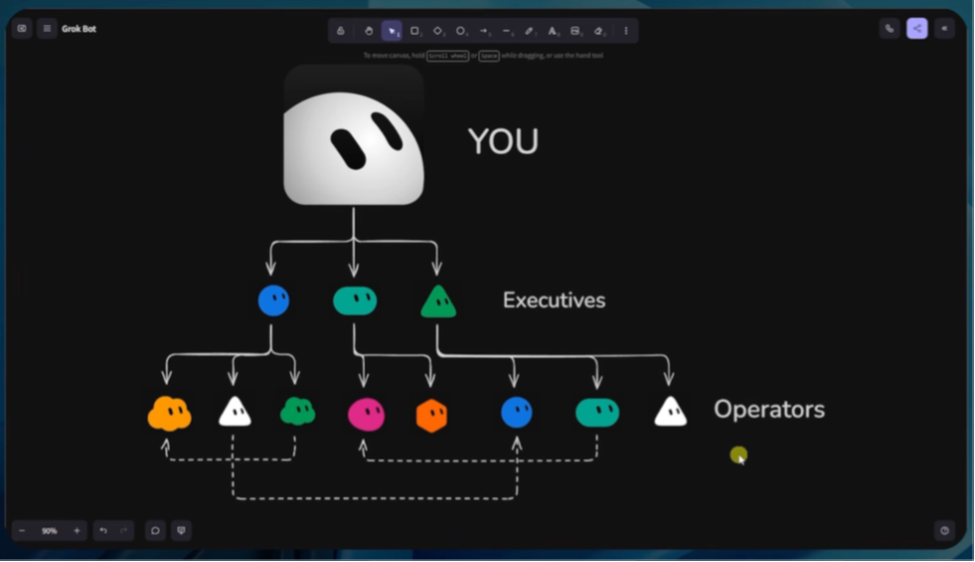
Grok was first out of the gate with Grok Bot, pushing beyond the single-agent model into multi-agent swarms where executive-style agents can delegate work to specialist agents. Meta soon followed with Meta Muse, a more personal agentic system designed to track goals, move across digital services, monitor changing conditions, create artifacts, and keep work moving until human judgment or approval is required.
Then, most recently, OpenAI entered the fray with OpenAI Dot — an always-on agent that can be assigned an ongoing responsibility, continue working while you are away, monitor connected systems, and proactively surface what deserves your attention.
Bots. Dots. Muses. Different names, different interfaces, different use cases — but underneath them is the same broader shift. AI is moving from something we simply consult to something we increasingly delegate to, organize, coordinate, and govern.
The next important layer of AI may therefore not simply be another smarter model. It may be what I call the Orchestration Layer — the architecture that determines how AI agents, responsibilities, tools, workflows, and humans work together. Once that layer begins to emerge, AI starts looking less like software and more like something organizations have been designing for centuries: a system of work.
From Task Delegation to Responsibility Delegation
For most of the Generative AI era, our relationship with AI has been transactional. Write this email. Analyze this spreadsheet. Summarize this document. Research this issue. Create this presentation. The fundamental unit of interaction has been the task.
OpenAI Dots points toward a different model. Instead of telling an AI what to do every time, you can increasingly tell it what to take care of. Imagine assigning an agent this responsibility:
“Own the product-launch materials. Keep them updated. Flag inconsistencies. Draft what needs drafting. Never change pricing. Escalate anything affecting the launch date.”
That sounds less like a prompt and more like a role.
In one example shared for Dots, the agent monitored product-launch documents against standing rules, detected a pricing inconsistency, escalated it, updated drafts, revised email copy, and continued working without needing a fresh instruction at every step.
The distinction matters because a task ends when the output is delivered, while a responsibility persists. That gives us an important shift:
Task Delegation → Responsibility Delegation
The real breakthrough of Agentic AI may therefore not be that AI performs more tasks. It may be that AI increasingly holds persistent responsibility within defined boundaries. And once AI begins holding responsibilities, we encounter a problem organizations know very well: how should those responsibilities be divided?
When AI Starts Looking Like an Organization
This is where Grok Bot becomes particularly interesting.
AI systems often encounter a common failure mode within the multi-agent framework: the Mega-Agent — one AI expected to know everything, use every tool, handle every process, and solve every problem. As complexity increases, so do context overload, routing confusion, and execution failure.
The proposed alternative is surprisingly familiar: specialization and hierarchy.
A human sits at the top. Beneath the human are executive-style agents such as a Chief of Staff, COO, Content Officer, or CFO. Those agents then delegate to narrower operator agents responsible for functions such as inbox management, task creation, meeting records, or media production.
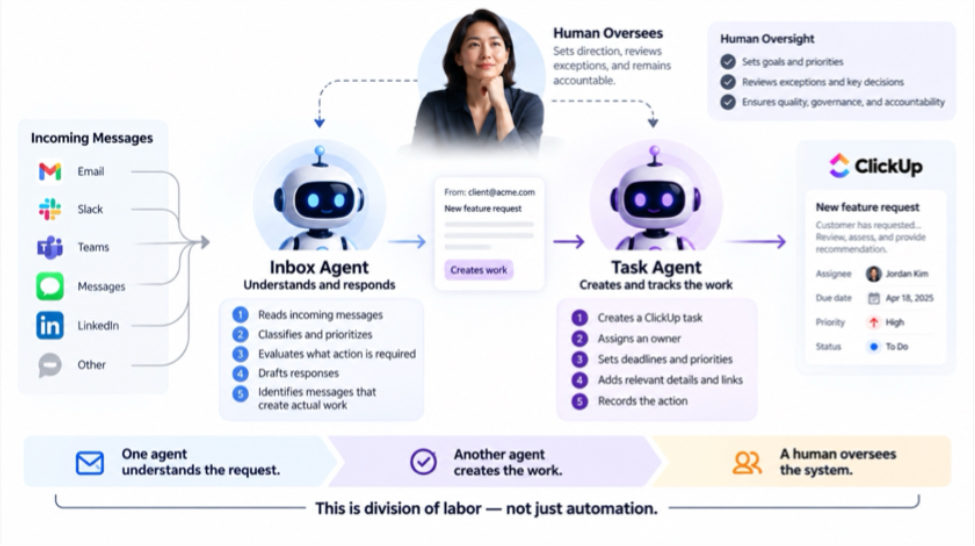
One example makes this tangible. An Inbox Agent reads incoming messages, classifies them, evaluates what action is required, and drafts responses. If a message creates actual work, it hands that work to a separate Task Agent, which creates a ClickUp task, assigns an owner, establishes deadlines, and records the action.
One agent understands the request; another creates the work; a human oversees the system. That is no longer just automation. It is division of labor.
This leads to a deeper idea:
The same reasons humans created organizations may eventually be the reasons we organize AI.
Human organizations exist because no single person can know everything, do everything, monitor everything, and make every decision. So we create specialization, roles, delegation, coordination, escalation, and governance. AI appears to be running into the same architectural problem.
The answer may not always be to build one increasingly gigantic intelligence. Sometimes the answer may be to organize intelligence better.
The Orchestration Layer
This is where Bots, Dots, and Muses begin to converge. Together, they reveal the need for something above the individual agent: a layer that determines how all of this intelligence works together.
That is the Orchestration Layer – the system through which responsibilities, agents, tools, permissions, workflows, timing, escalation, and human oversight are coordinated.
It answers questions organizations already understand intuitively. Who — or what — owns this responsibility? Which agent should do the work? What information does it need? What systems may it access? What can it initiate without asking? When should it hand work to another agent? What requires human approval? When should it stop and escalate?
These are not merely technical routing decisions. They are operating-model decisions.
An AI agent by itself is simply a capability. Orchestration turns capability into organized work. That may eventually become one of the most important differences between companies that merely use AI and companies that genuinely redesign themselves around it.
From Conversation to Environment
Meta Muse highlights another dimension of the shift.
Traditional AI largely waits inside the conversation. We open the application, ask something, receive the answer, and leave. An agent such as Muse is designed to operate across the environment in which our work and lives actually happen.
For example, it can monitor prices in an e-commerce platform and alert the user when something changes. It can work across saved social-media content and turn travel ideas into an itinerary. It can navigate authenticated websites, move through a purchase flow, and stop at the consequential point where human approval is required.
The important change is not simply that Muse can use more tools. It is that AI is moving from being conversation-centric toward becoming environment-centric.
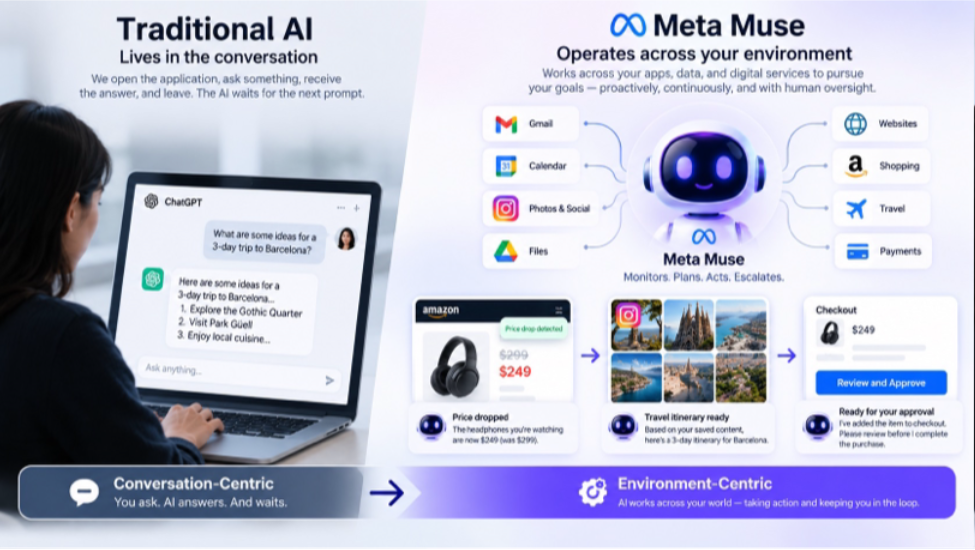
Its relevant world increasingly includes files, calendars, messages, social content, websites, credentials, payments, project systems, and long-running goals. That changes the management problem dramatically.
The question is no longer only, “What can the AI understand?” It becomes: “What can it see, what can it touch, what can it change — and under whose authority?”
The more AI moves into the environment, the more important orchestration becomes.
The Agentic Operating Model
The Grok Bot framework implies four elements for making agents operational: Context, Connections, Capabilities, and Cadence — what the agent knows, what systems it can use, what it knows how to do, and when it acts.
I would add a fifth: Governance.
Because knowing, connecting, acting, and repeating are not enough. The system must also know its boundaries.
That gives us a useful way of thinking about the emerging Agentic Operating Model:
Context + Connections + Capabilities + Cadence + Governance
The AI model provides intelligence. The operating model determines how that intelligence is allowed to participate in work.
That distinction may prove increasingly important as frontier models themselves become broadly available. Competitive advantage may not come simply from having access to the smartest AI. Many companies may eventually have access to comparable levels of machine intelligence.
The differentiator may become how effectively an organization structures and orchestrates that intelligence.
The AI Chief of Staff Becomes an Orchestrator
This also makes an idea I have explored previously in Culture & Code much more concrete: the AI Chief of Staff.
READ:
The end of the job description: When everyone has an AI chief of staff, who actually owns the work?
Imagine an executive with an AI researcher, analyst, writer, planner, scheduler, and monitoring agent. If the human has to personally coordinate every handoff among them, we have simply created another management burden. Something has to sit between the human and the swarm.
That is the orchestrator.
The human sets direction and defines what matters. The AI Chief of Staff converts that direction into coordinated work. Specialist agents execute within their domains, while the orchestrator manages routine handoffs and escalates consequential decisions back to the human.
The relationship with AI therefore begins to change. Instead of constantly saying, “Research this. Write this. Check that. Update this,” the manager increasingly says:
“This is the outcome I need. Organize the work.”
That may be one of the defining transitions of the Agentic Era: the human moves from directing every task toward designing and governing the system through which tasks are accomplished.
From Prompt Engineering to Agentic Organization Design
For several years, the AI conversation focused heavily on Prompt Engineering. More recently, attention has shifted toward Context Engineering — making sure AI has access to the right information.
But once we begin building teams of agents, another discipline becomes necessary:
Agentic Organization Design
Suddenly, the questions sound remarkably familiar to anyone who has designed organizations. What responsibilities exist? Which should be combined and which should be separated? What should be centralized? What requires specialization? Who — or what — can make which decisions? What information should be shared? What should remain restricted? Where should escalation occur? Who remains accountable?
These are not merely technical questions. They are organizational questions expressed through technology.
This leads to perhaps the larger thesis of the article:
The Agentic Enterprise may ultimately be less about building smarter AI and more about designing better systems of intelligence.
We are moving from asking how humans can use AI toward asking how human and artificial intelligence should be organized together.
The Manager Becomes an Orchestrator
This also extends what I previously called The Great Management Rewrite.
Traditional management was designed primarily around coordinating human capability. Managers distribute work, establish priorities, resolve issues, develop people, and remain accountable for results.
But consider a manager with six human employees and twenty specialized agents. Or ten employees supported by fifty digital workers. Or an executive whose AI Chief of Staff coordinates an entire network of specialist agents behind the scenes.
The traditional concept of Span of Control begins to become incomplete.
What increasingly matters is Span of Intelligence:
How much human and artificial intelligence can one leader effectively direct, coordinate, understand, and govern?
That may become a far more important measure of management capacity in the years ahead. The manager’s job shifts from supervising every unit of work toward designing the system through which work gets done.
That is orchestration.
But Agents Must Earn Autonomy
There is, however, an important danger in getting carried away with the organizational metaphor. Adding more agents does not automatically create a better system. It can create more interactions, more failure points, more dependencies, and more opportunities for problems to propagate.
The Grok Bot reference recommends a staged progression from Guided, to Supervised, to Autonomous operation. Agents initially create drafts for human review, then receive authority to perform actions subject to approval, and only later operate independently within established controls and auditing.
This maps closely to the Human × AI progression I have discussed previously:
Human in the Loop → Human on the Loop → Human Above the Loop
But multi-agent systems add another complication. One agent behaving badly is one problem; fifty agents handing work to one another can become a systemic problem. The greater the number of agents and the more interconnected they become, the more important role clarity, permissions, monitoring, escalation, and accountability become.
This suggests another principle: Agents should earn autonomy. Systems should earn orchestration.
Or more simply: The more organized AI becomes, the more organized human governance must become around it.
From Organizations of People to Organizations of Intelligence
For more than a century, Organization Design has fundamentally asked: How should we organize people to accomplish work?
The Agentic Era introduces a broader question: How should we organize intelligence to accomplish work?
That intelligence increasingly comes from people, AI models, specialized agents, teams, workflows, and collective systems operating together. The evolution might therefore look less like a progression of technologies and more like a progression of organization:
AI Tool: Does a task.
↓
AI Assistant: Helps a human.
↓
AI Agent: Pursues an objective.
↓
AI Team: Specialized agents collaborate.
↓
AI Organization: Agents operate through roles, responsibilities, delegation, and workflows.
↓
Agentic Enterprise: Human and artificial intelligence operate together under a shared organizational and governance architecture.
That last stage may require us to think differently about Organization Design itself, because the future organization will no longer simply be an organization of people.
It may increasingly become an: Organization of Intelligence
And that may be the most consequential idea behind Bots, Dots, and Muses.
Bots, Dots, Muses — and What Comes Next
Bots, Dots, and Muses may sound like clever product names, but behind them is a much bigger shift. We are moving from AI as interface, to AI as worker, to AI as organized system.
We spent much of the first AI era asking how many employees would eventually use AI. The more interesting question may soon be how many AI agents each employee — or each manager — will orchestrate.
Once agents begin holding responsibilities, delegating to other agents, coordinating specialized work, monitoring environments continuously, and acting across enterprise systems, the language of “AI assistants” may no longer be enough. We will increasingly be designing Organizations of Intelligence.
The companies that gain the greatest advantage may therefore not simply be those with access to the smartest models. They may be those that learn how to structure, orchestrate, and govern human and artificial intelligence as one operating system.
Because the future of Organization Design may no longer be only about deciding where people sit on the org chart. It may increasingly be about deciding where intelligence sits — and how all of it works together.