DATE
Loading...
TIME
Loading...
About Us
A Filipino online content creator has warned fellow creators against a suspicious email circulating online that appears to impersonate global energy drink brand Red Bull, raising concerns over phishing attempts targeting digital creators.
Azrael Coladilla, the creator behind “Azrael’s Merryland Blog” shared screenshots of the email, which claims to be from a “small team” at Red Bull that allegedly discovered his channel and expressed interest in a casual discussion with no set brief or expectations. The message encourages recipients to reply so the conversation can “take it step by step.”
According to Coladilla, similar messages have recently surfaced across creator communities, with scammers using well-known brand names to appear credible and lower recipients’ guard. He warned that engaging with these emails — especially by replying or clicking links — could lead to account compromise or hacking.
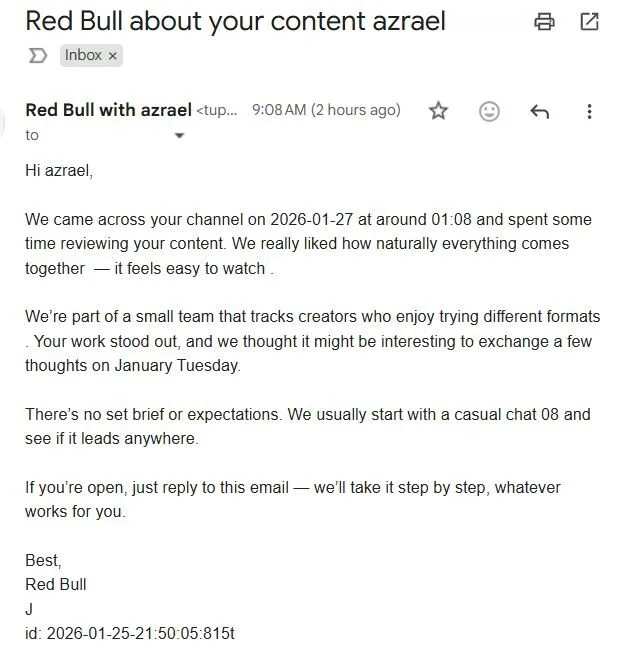
Photo courtesy of Azrael Coladilla
“May nakita na akong ganito recently sa isang page. Kapag nakipag-engage ka pa dito, malamang ma-hack ka na,” Coladilla cautioned, urging creators to remain vigilant.
(I’ve already seen something like this recently on a page. If you engage with it further, there’s a good chance you’ll get hacked.)
Scam Watch Pilipinas co-founder Jocel de Guzman has advised creators to verify brand collaborations through official company domains, established agency contacts, or verified social media accounts.
“Phishing is a deception tactic designed to exploit trust. Scammers often pose as legitimate brands, agencies, or institutions to lure people into clicking malicious links or sharing sensitive information,” de Guzman said.
“Scam Watch Pilipinas also encourages newcomers in content creation to be cautious and avoid accepting proposals immediately, especially if they seem too good to be true. Verifying communications through official company domains, established contacts, or verified social media accounts is critical before engaging or responding,” Scam Watch Pilipinas co-founder added.
De Guzman also encouraged content creators to share scam-related content they encounter on Scam Vault PH, a Facebook group pioneered by Scam Watch Pilipinas, the Cybercrime Investigation and Coordinating Center (CICC), Gogolook Philippines, and the Philippine National Police–Anti-Cybercrime Group (PNP-ACG).
He also requested content creators to download the Whoscall app, a global anti-scam application, and to report scam-related incidents to 1326, the national anti-cybercrime hotline.
Phishing or link-based attacks is one of the digital threats in the Philippines, according to data from the Whoscall 2025 Philippines Scam Report.
The report, published by Gogolook, the world’s leading TrustTech company, through Whoscall app, reported that risky URLs rose from 13,602 in the first quarter to 49,431 by the end of 2025 — an almost four-fold increase.