DATE
Loading...
TIME
Loading...
About Us

By Joey Briones
Walk down the street today (at least in some first–world countries) and you might meet one of the newest members of the workforce: a cheerful little delivery robot rolling confidently toward your front door.
If you believe the marketing, these machines are fully autonomous, self-driving, self-navigating, and one firmware update away from replacing entire job categories.
But spend a little more time behind the scenes, and a different story emerges:
Behind every “autonomous” robot is a human.
Often several.
Sometimes an entire global workforce.
The artificial intelligence (AI)+Robotics revolution isn’t a story of humans disappearing.
It’s a story of humans moving — from the sidewalk to the control room, from the front office to the backend, from the visible workforce to the invisible one.
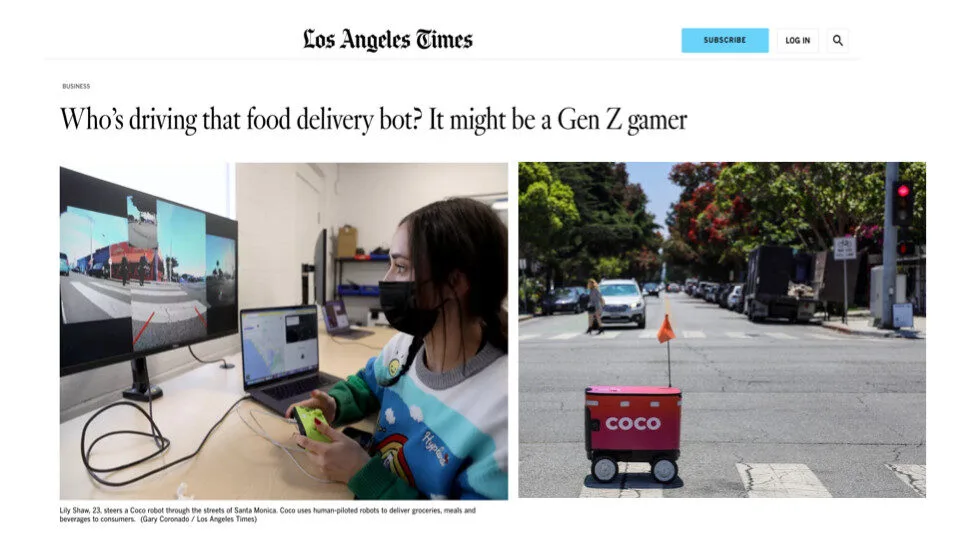
Welcome to the new world of AI-powered logistics, where robots deliver your burrito, and a human 10,000 kilometers away makes sure it doesn’t end up in a storm drain.
This is not a contradiction.
This is the operating model of the future.
The Illusion of Autonomy: The Robot Does the Work . . . Until It Doesn’t.
Robots look autonomous.
Robots act autonomous.
Robots are marketed as autonomous.
But robots are not really autonomous.
They struggle with:
And when they get stuck, confused, threatened, or lost, they do what any reasonable machine does:
They call a human.
In fact, some companies rely on hundreds of remote operators in the Philippines (yes, we are becoming a major talent offshoring hub for this), India, Colombia, and other countries who monitor robot fleets in real time — taking over, guiding, or correcting their behavior in split-second interventions.
This is the real magic of the model:
Robots handle the simple tasks.
Humans handle the complex ones.
This isn’t the replacement of human labor.
This is the redistribution of human labor.
And that shift has massive implications.
The Rise of the “Ghost Workforce” Powering AI.
Gig workers were the invisible labor behind the on-demand economy.
Remote robot operators are the invisible labor behind the autonomous one.
We are witnessing the emergence of a new class of work:
Digital Blue-Collar Labor
Workers who operate machines they never physically touch
to perform tasks in cities they may never visit
for customers they will never meet.
This workforce:
Without these workers, none of the robots rolling down the street would function properly.
So here’s the rub – autonomy isn’t eliminating work; it’s creating new forms of work that sit behind the scenes.
This is both fascinating and uncomfortable:
We have made robots visible and workers invisible.
A new “in-the-loop” workforce exists — critical, uncredited, and growing.
Why Human-in-the-Loop Isn’t Optional — It’s the Critical Success Factor.
There is a myth in the tech world:
“If we collect enough data, AI will eventually stop needing humans.”
Reality paints a different picture:
The more robots you deploy,
the more edge cases you encounter.
And edge cases are where robots fail.
And when robots fail, humans intervene.
And that intervention generates the data that improves the system.
Humans don’t slow AI down.
Humans teach AI.
Humans stabilize AI.
Humans scale AI.
This is why every major robotics company still relies on a hybrid operating model.
Autonomy is not a destination; it is a spectrum. And human judgment remains the final guardrail.
Robots can sense, calculate, and navigate.
But only humans can:
AI handles the predictable.
Humans handle the unpredictable.
This division of labor is not a weakness.
It is the blueprint of all successful AI systems.
What This Means for Leaders: Design Hybrid Systems, Not Human-Free Ones.
If robots and AI are here to stay — and they will — then leaders must rethink how organizations function.
Here are the imperatives:
1. Recognize that human oversight is strategic infrastructure.
Treat your human-in-the-loop workforce not as cost, but as capability.
2. Design the workflow for humans + AI, not humans vs AI.
Autonomy is a team sport.
3. Build skill pathways for the new “robot operator” roles.
These jobs require situational awareness, judgment, and problem-solving — not just button-pushing.
4. Protect the flow of expertise.
If robots absorb entry-level tasks, companies must create new ways for novices to learn — or risk a skill collapse.
5. Lead with transparency.
If your robots rely on humans, acknowledge it.
Invisible labor should not remain invisible.
The Robots Are the Future — But So Are We.
We are now seeing a world rapidly shifting toward automation.
But it also reveals something more profound:
The future of work will not be robotic.
It will be hybrid.
Machines will move through our streets.
Humans will guide them from afar.
AI will optimize logistics.
Humans will handle the chaos.
This isn’t a story about replacement.
It’s a story about rebalancing — about learning where machines excel and where humans remain irreplaceable.
Autonomy isn’t the absence of humans.
Autonomy is what humans achieve with machines.
And the organizations that will thrive will be the ones that embrace this truth:
AI will make work faster; robots will make work scalable.
But humans will always make work possible.
This is why the AI + Robotics Revolution still runs on Human Judgment, Human Labor, and Human Wisdom.