DATE
Loading...
TIME
Loading...
About Us

Imagine an AI that diagnoses disease more accurately than most doctors, predicts employee performance better than most managers, evaluates credit risk more consistently than most bankers, and detects patterns in legal cases faster than any judge ever could.
Now imagine that same AI deciding whom a company should hire or fire, who deserves a promotion, who should receive a loan, who should be denied treatment, or how long someone should spend in prison. At that point, the most important question is no longer simply “Can AI make the decision?” It becomes a much harder one:
“Should AI be allowed to make the decision?”
That distinction may become one of the defining leadership questions of the Agentic Era.
For years, much of the AI conversation has focused on capability. What can we automate? Which tasks can AI perform? How much human involvement can we remove? How far can we move from Human in the Loop, to Human on the Loop, and eventually Human Above the Loop?
But perhaps we have been interpreting that progression too narrowly. The objective should not simply be to keep moving humans farther away from the work. The more important question is where humans should sit in relation to each decision — and which decisions should never leave human hands at all.
Some decisions may be appropriate for AI to make autonomously within clear boundaries. Others should keep humans actively involved. Still others may require humans to remain above the system — setting direction, defining guardrails, exercising judgment, and retaining final authority.
That is where the conversation now needs to move.
We May Have Been Asking the Wrong Question
Most organizations approach AI adoption through an efficiency lens. Where can we reduce manual effort? Which decisions can be automated? What can machines do faster, cheaper, or more consistently?
Those are valid questions, but they are incomplete.
The Agentic Era introduces another: Which decisions should remain human even when AI becomes technically capable of making them?
This is not an argument against AI. Quite the opposite. The more capable AI becomes, the more deliberately we need to define where its authority should begin and end.
Routine, repetitive, rules-based, reversible, and low-consequence decisions are often ideal candidates for greater AI autonomy. But the fact that AI can produce a recommendation — or even outperform humans statistically — does not automatically mean it should possess the final decision right.
That gives us an important distinction: AI Capability ≠ AI Authority
Capability asks: Can the system make the decision?
Authority asks: Should the system have the right to make it?
Those are not the same question. Confusing them may become one of the most consequential governance mistakes organizations make.
The Human Decision Boundary
I call this the Human Decision Boundary:
The point beyond which decision authority should remain with a human because the outcome requires human judgment, accountability, legitimacy, or moral responsibility.
The boundary will not sit in exactly the same place for every organization, industry, or society. It will shift depending on context, consequence, culture, and the nature of the decision itself.
But the principle matters because it changes the objective from maximum automation to intentional decision allocation.
Some decisions sit comfortably on the AI side of the boundary. Others belong in the middle, where AI analyzes and recommends while humans remain actively involved. Still others may belong firmly on the human side, regardless of how capable the technology becomes.
The real question therefore is not simply Human or AI?
It is: Where should the human sit relative to this decision?
That is where Human in the Loop, Human on the Loop, and Human Above the Loop become more than technical descriptions. Together, they form a practical decision architecture.
Where Should the Human Sit?
In Human in the Loop, the human remains actively involved in the workflow. AI may provide analysis, recommendations, or proposed decisions, but the human reviews, challenges, corrects, approves, or decides as part of the process.
In Human on the Loop, AI operates with greater autonomy. The human supervises the system, monitors performance, handles exceptions, and intervenes when necessary.
In Human Above the Loop, AI may perform and coordinate much of the underlying work while the human moves to a higher level: setting objectives, defining boundaries, establishing guardrails, exercising judgment on consequential issues, and remaining accountable for the outcome.
These should not be understood simply as stages toward removing humans. They are different allocations of decision authority.
A hiring decision may require Human in the Loop. AI can screen evidence and recommend candidates, but humans remain directly involved in assessing context, potential, and fit.
A routine expense claim may appropriately sit with Human on the Loop. AI can approve within established rules while humans monitor anomalies.
An enterprise strategy decision may place leaders Human Above the Loop. AI can analyze markets, competitors, scenarios, financial consequences, and risks, but leadership still sets direction, weighs trade-offs, and owns the final choice.
The right model depends on the decision. The real progression should therefore not automatically be:
Human in the Loop → Human on the Loop → Human Above the Loop → Human Out of the Loop
as though human absence were always the destination.
A better progression is:
Participation → Supervision → Governance → Reserved Human Authority
The human role changes. Human responsibility does not necessarily disappear.
Not Every Decision Is the Same
Organizations often speak about “decision-making” as though all decisions were fundamentally alike. They are not.
Some decisions are operational; others are strategic. Some are easily reversible; others are permanent. Some affect a process or transaction; others affect a person’s livelihood, freedom, health, dignity, or future.
AI is particularly well suited for decisions that are repetitive, rules-based, data-rich, reversible, and low consequence. The case for stronger human involvement increases as decisions become ambiguous, value-laden, irreversible, high consequence, and deeply human-impacting.
The closer a decision moves toward the second category, the closer it approaches the Human Decision Boundary.
Low-consequence decisions may move toward Human on the Loop.
Context-rich decisions may require Human in the Loop.
Highly consequential decisions may require Human Above the Loop, with AI doing much of the underlying analysis while humans retain judgment and authority.
The goal is not maximum human involvement. It is putting the human in the right place.
When Human Dignity Is at Stake
Consider decisions involving hiring, termination, promotion, disciplinary action, healthcare, education, or criminal justice. AI can contribute enormous value in all of these areas. It can identify patterns, reduce administrative burden, surface evidence, detect inconsistencies, and challenge human bias.
But when a decision materially affects another person’s status, rights, livelihood, health, or future, there is a strong argument that a human should remain visibly responsible for the final judgment.
That is not because humans are always more accurate. Often, they are not. The deeper issue is that certain decisions carry human meaning, and the legitimacy of the outcome may depend partly on someone being able to understand context, explain the reasoning, and stand behind the consequence.
A rejected job applicant may accept that AI helped screen thousands of resumes. But being told that an algorithm alone decided they were unworthy of employment raises a different issue.
A patient may welcome AI-supported diagnosis. But when the discussion turns to whether treatment should continue, whether risk is acceptable, or how to weigh quality of life, the problem is no longer purely analytical.
At that point, prediction gives way to judgment.
When Values Collide
AI performs exceptionally well when the objective is clear. Leadership rarely operates in a world of perfectly clear objectives.
Real decisions involve competing priorities: profit versus people, speed versus safety, efficiency versus fairness, individual interest versus collective good, short-term gain versus long-term trust.
These are not simply optimization problems. They are value choices.
AI can help quantify trade-offs, model scenarios, estimate consequences, and identify options humans might miss. But eventually someone must decide which value matters more in this situation.
That is not simply intelligence. It is judgment.
And this is where Human Above the Loop becomes especially important. The leader does not need to perform every analysis personally. AI can do much of that work. But the leader remains responsible for determining what the system should optimize for, which trade-offs are acceptable, and where the boundaries lie.
Being Above the Loop, therefore, is not a retreat from responsibility.
It is a concentration of it.
When the Decision Cannot Be Easily Reversed
Another important consideration is reversibility.
If AI recommends a weak email subject line, the consequence is trivial. If it makes a poor inventory decision, the organization may recover. If it approves an incorrect expense reimbursement, the mistake can usually be corrected.
But some decisions are difficult — or impossible — to reverse: a life-changing medical intervention, a major capital commitment, a severe disciplinary action, a criminal sentence, a military strike, or a critical infrastructure shutdown.
The less reversible the outcome, the stronger the case for retained human authority.
The more irreversible the consequence, the stronger the case for human ownership.
This does not mean AI should be excluded from high-consequence decisions. In fact, such decisions may benefit most from AI’s ability to analyze evidence, model alternatives, simulate consequences, and expose blind spots.
But support is not the same as sovereignty.
AI may perform 95% of the analytical work while the final 5% remains a distinctly human act of judgment. That is not failed automation. It is intentional governance.
The Legitimacy Gap
There is another dimension we often underestimate: some decisions derive legitimacy partly from who makes them.
An employee terminated by an algorithm may experience the decision very differently from one made and explained by a leader who is prepared to own it. A family receiving devastating medical news may value AI-derived insights but still expect a physician to exercise judgment, explain uncertainty, and take responsibility. A citizen facing a criminal sentence may demand more than statistical accuracy from the authority imposing it.
This suggests another concept: the Legitimacy Gap.
The Legitimacy Gap is the distance between AI’s ability to produce a decision and society’s willingness to accept AI as the rightful authority to make it.
That gap may persist even if AI becomes highly accurate, explainable, and reliable.
We may one day build AI systems that outperform human judges in predicting recidivism, human managers in forecasting employee performance, or human doctors in estimating treatment outcomes. Yet society may still decide that certain decisions require human authority because the decision itself carries moral, social, or institutional weight.
The question is not merely whether AI can generate a better answer. It is whether we are prepared to grant it the moral and institutional authority to decide.
The Decision Rights Ladder
Organizations therefore need a more explicit way to determine how much authority AI should hold.
One useful model is a Decision Rights Ladder, which maps naturally to Human in the Loop, Human on the Loop, and Human Above the Loop.
1. AI Informs — Human in the Loop
AI provides data, patterns, evidence, forecasts, and analysis. The human interprets that information and makes the decision.
2. AI Recommends — Human in the Loop
AI proposes a preferred course of action, but the human challenges assumptions, applies context, considers values, and decides.
3. AI Decides Within Guardrails — Human on the Loop
AI makes routine decisions inside clearly defined rules and limits. Humans monitor the system, review exceptions, and intervene when necessary.
4. AI Decides, Human Can Override — Human on the Loop
AI acts by default while humans supervise outcomes and retain override authority. Human involvement becomes exception-based.
5. Human Must Decide — Human Above the Loop
AI may perform almost all of the underlying analysis, simulation, recommendation, and preparation. But because the decision involves major consequence, values, legitimacy, or accountability, final authority remains human.
That final level is important. Human Above the Loop does not mean humans no longer decide. For some of the most consequential choices, it may mean exactly the opposite: AI performs more of the underlying work so that humans can concentrate on the decision that actually matters.
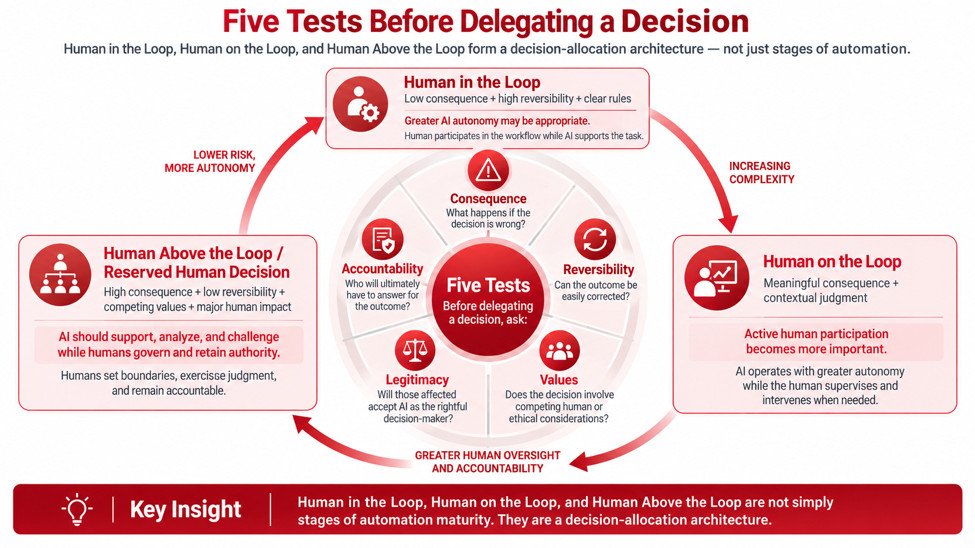
Five Tests Before Delegating a Decision
Before deciding whether the human should remain in, on, or above the loop, leaders should consider five tests:
Taken together, these questions help determine the appropriate human position.
At one end: Low consequence + high reversibility + clear rules
Greater AI autonomy may be appropriate.
Human in the Loop.
Toward the middle: Meaningful consequence + contextual judgment
Active human participation becomes more important.
Human on the Loop.
At the far end: High consequence + low reversibility + competing values + major human impact
AI should support, analyze, and challenge while humans govern and retain authority.
Human Above the Loop / Reserved Human Decision.
Seen this way, Human in the Loop, Human on the Loop, and Human Above the Loop are not simply stages of automation maturity.
They are a decision-allocation architecture.
Human Above the Loop Does Not Mean Human Away From the Decision
As AI becomes more capable, humans will naturally perform less of the underlying work. That is part of the promise of AI. But less human execution should not automatically mean less human responsibility.
Human Above the Loop means moving upward — to define purpose, objectives, boundaries, guardrails, values, escalation rules, and accountability.
Sometimes the leader will allow AI to make decisions autonomously within those boundaries. Sometimes intervention will occur only when exceptions arise. And sometimes the leader will say:
“Everything up to this point can be automated. This decision remains ours.”
That may become one of the defining acts of leadership in an AI-rich organization.
The future role of the human may not be to touch every task. It may be to know which decisions must still carry a human signature.
Work Architecture and Decision Architecture
This is ultimately not only an AI governance issue. It is also an Organization Design issue.
Organizations have always been shaped by two fundamental questions:
Who does the work?
and:
Who has the authority to decide?
AI forces us to separate those questions more explicitly.
That gives us two increasingly important architectures –
Work Architecture: Who — or what — performs the task?
Decision Architecture: Who — or what — has the authority to decide?
Human in the Loop, Human on the Loop, and Human Above the Loop become building blocks of that Decision Architecture.
One workflow may allow AI to process thousands of routine transactions while humans remain in the loop, monitoring exceptions. Another may keep managers on the loop because contextual judgment is essential. A third may place senior leaders above the loop, governing highly autonomous systems while retaining authority over consequential strategic choices.
The sophistication lies not in maximizing autonomy.
It lies in putting the human in the right place.
The Human Premium May Be Decision Sovereignty
In an earlier Culture & Code discussion, I explored the idea that as artificial intelligence becomes abundant, human judgment becomes more valuable.
Perhaps the deeper human premium is not merely judgment. It is Decision Sovereignty:
The human authority to make and own consequential choices.
AI may become better at analysis, prediction, recommendation, simulation, and pattern recognition. But authority is not automatically transferred by competence.
Organizations and societies may still decide that certain choices should remain human because those choices define what we value, how we treat one another, and who must answer for the consequences.
That gives us a progression:
Artificial Intelligence → Human Judgment → Human Accountability → Decision Sovereignty
The more intelligence machines acquire, the more deliberately humans may need to decide which choices remain ours.
The Last Human Decision
Eventually, AI may outperform humans at many decisions we currently consider uniquely ours. That possibility should neither frighten us into rejecting AI nor seduce us into delegating everything simply because machines can act faster, cheaper, or even more accurately.
The more mature question is not “How much decision-making can we automate?” It is “Where should automation stop — and where should the human sit?”
Sometimes the right answer will be Human in the Loop, actively participating in the judgment. Sometimes it will be Human on the Loop, supervising increasingly autonomous systems. Sometimes it will be Human Above the Loop, setting direction, defining boundaries, governing the system, and retaining authority over the decisions that matter most.
And sometimes, regardless of how capable AI becomes, the answer should simply be:
This decision remains human.
The defining challenge of the next AI era may therefore not be how quickly we can remove humans from the loop. It may be how intelligently we decide where humans must remain in it, on it, or above it — and where AI authority must stop altogether.
Because perhaps the last human decision will be the most important one of all:
Deciding which decisions must remain human.