DATE
Loading...
TIME
Loading...
About Us

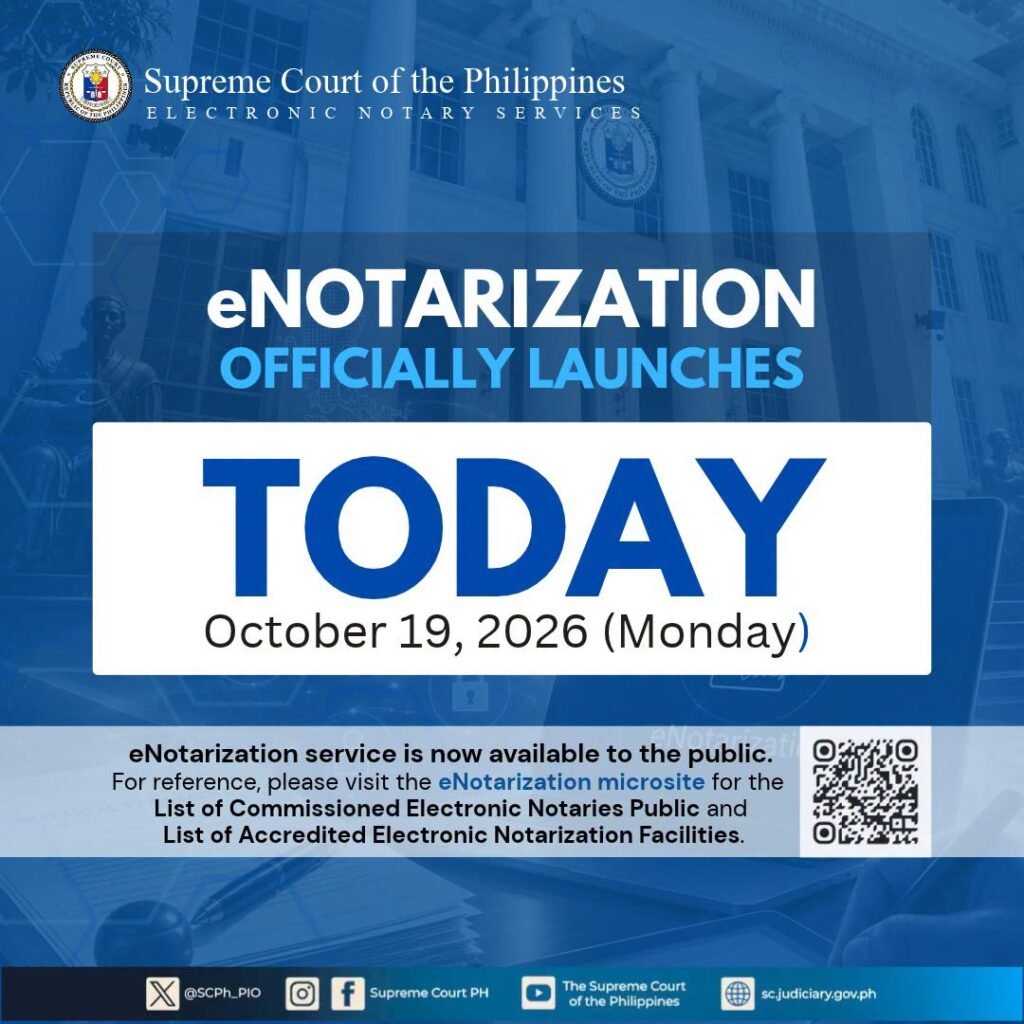
The Supreme Court of the Philippines officially launched its electronic notarization (eNotarization) service on Monday, Oct. 19, allowing Filipinos to have electronic documents notarized online through accredited platforms.
The initiative aims to make notarization more convenient and accessible by enabling the public to process electronic documents digitally instead of relying solely on traditional, in-person notarization.
In an announcement, the Supreme Court confirmed that eNotarization is now operational and available to the public through its first batch of accredited Electronic Notarization Facilities (ENFs).
These include Twala, QLegal, and NotarizeIT, which have been authorized to provide electronic notarization services.
To use the service, individuals must first register with one of the accredited ENFs through their respective registration portals, accessible through the Supreme Court’s official eNotarization website.
After registration, users can select an Electronic Notary Public (ENP) from the Supreme Court’s published list of commissioned electronic notaries.
The system provides a digital channel for notarizing electronic documents, potentially reducing the need for physical visits to notarial offices and simplifying transactions for individuals and businesses.
However, users must still comply with the applicable requirements and procedures for electronic notarization, including those implemented by the accredited platforms and commissioned electronic notaries.
The Supreme Court has also made instructional videos available to guide users through the registration and electronic notarization process.
For questions or technical concerns, the public may contact the Electronic Notary Services Helpdesk through its designated online form.
The launch marks another step in the Philippine judiciary’s digital transformation efforts, expanding the use of technology in legal services and providing the public with an alternative to conventional notarization.
The public may access the official eNotarization portal at https://sc.judiciary.gov.ph/enotarization/ https://sc.judiciary.gov.ph/enotarization to view accredited facilities, commissioned electronic notaries, and instructional materials.