DATE
Loading...
TIME
Loading...
About Us

Deep Web Konek has released an explainer aimed at clarifying misconceptions about the dark web amid renewed public discussion following recent shooting incidents in the Philippines.
The explainer distinguishes the dark web from the deep web and addresses misleading terminology, myths and sensational claims that have circulated in public discussions and on social media.
Deep Web Konek said the deep web generally refers to online content that is not indexed by search engines, including email, online banking, cloud storage, private databases and internal systems.
The dark web, meanwhile, is a smaller hidden part of the internet that is commonly accessed through specialized tools such as Tor.
The explainer also discusses how anonymity networks work and how they can be used for legitimate purposes such as privacy, journalism, research and whistleblowing, while also being abused for criminal activity.
It stressed that cybercrime is not exclusive to the dark web, with illegal activities also taking place on regular websites, social media platforms and messaging applications.
Deep Web Konek also addressed recurring claims involving livestreamed violence, underground marketplaces and other dark-web stories that are often repeated online without sufficient evidence.
The explainer noted that interest in the dark web is not new in the Philippines, with Filipino online communities discussing and documenting the subject for more than a decade.
Among the prominent figures associated with the country’s early deep web community were writers who used pen names, including “Caution” and “IncubusXXX” of “Deep Web Enigma,” “DeckardCain,” “Pycali” and “Raven” of Deep Web Readers, and “Zion” and “Lady L” of Deep Web World of Mysteries (DWWOM). These pages were among the known Filipino online communities that published and discussed content about the deep web and related topics.
The explainer noted that interest in the dark web is not new in the Philippines, with Filipino online communities discussing and documenting the subject for more than a decade.
It also emphasized the distinction between association and causation in criminal investigations.
Deep Web Konek said evidence that a suspect accessed the dark web or encountered violent material may be relevant to an investigation, but does not by itself prove that the material caused or influenced the crime.
Investigators would still have to establish what was accessed, who was involved, what interactions took place and whether those activities had any direct connection to the crime.
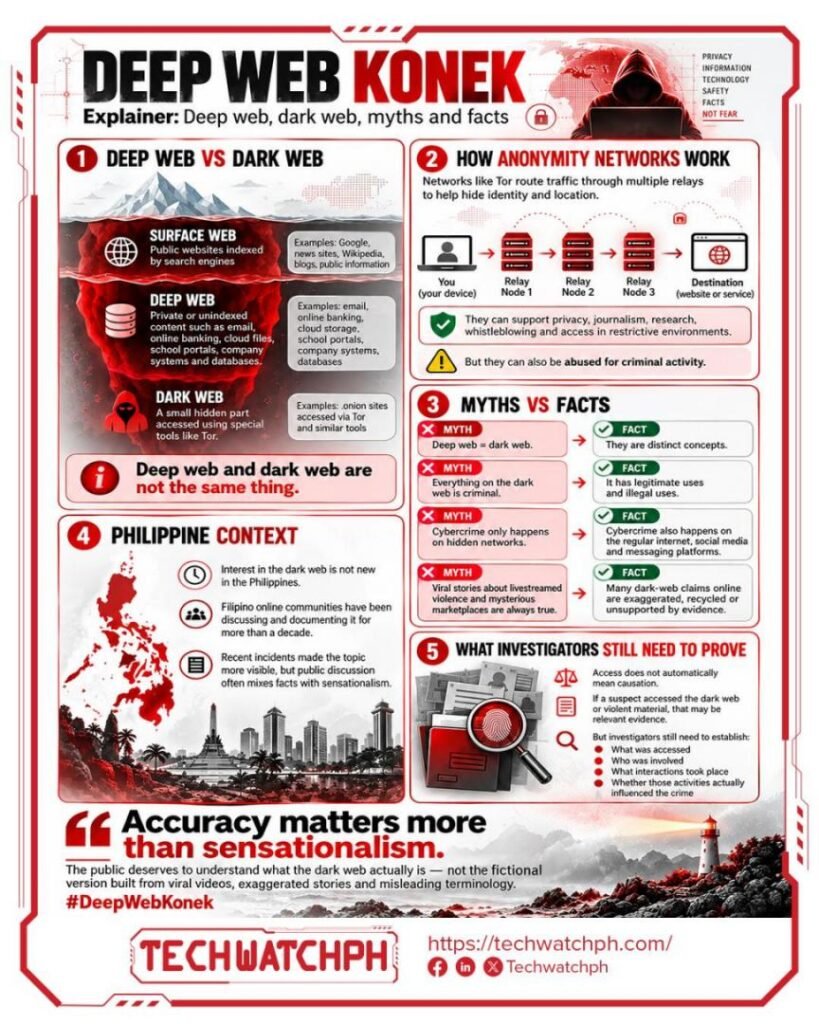
The explainer said accuracy is important as the dark web becomes increasingly cited in discussions surrounding complex criminal incidents, particularly when technical terms and unverified claims are presented as established fact.