Date
Loading...
Time
Loading...
About Us
Resources

The House of Representatives has approved on third and final reading a bill seeking to establish a National Cybersecurity Agency (NCSA) and strengthen the country’s framework for protecting critical information infrastructure from cyber threats.
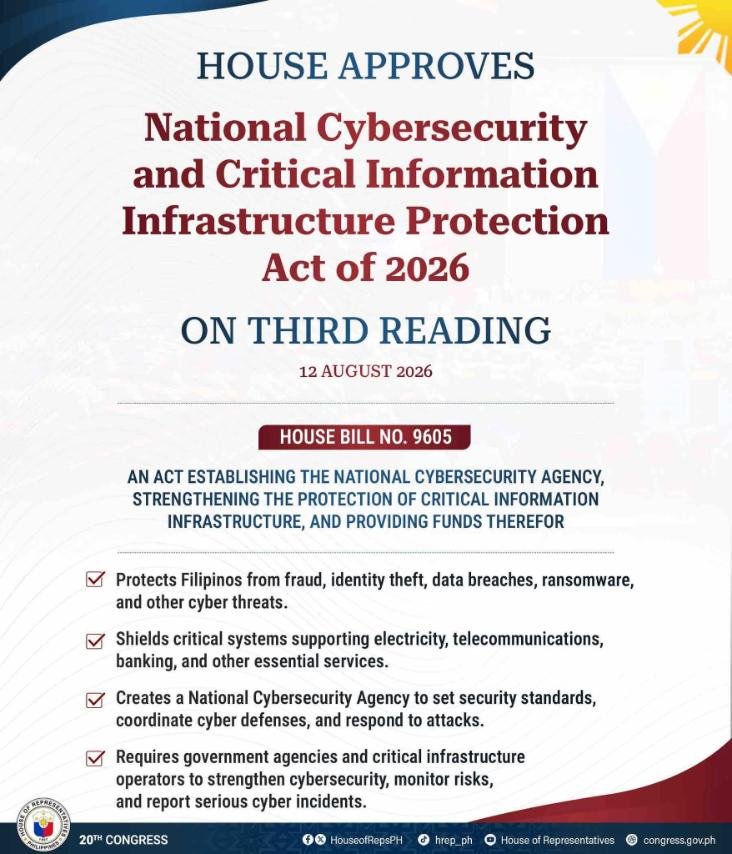
House Bill No. 9605, or the proposed “National Cybersecurity and Critical Information Infrastructure Protection Act of 2026,” was approved on Aug. 12.
The measure, one of the priority bills identified by the Legislative-Executive Development Advisory Council (LEDAC), seeks to strengthen the government’s response to threats such as online fraud, identity theft, data breaches, ransomware, and other cyberattacks.
Under the bill, the NCSA would be established under the Office of the President as the primary government body responsible for national cybersecurity policy, planning, coordination, implementation, and administration.
The proposed agency would be tasked with establishing minimum cybersecurity standards, auditing critical information infrastructure, coordinating responses to cyber incidents, and strengthening cyber threat intelligence sharing.
The Philippines currently has the National Computer Emergency Response Team (NCERT) under the Cybersecurity Bureau of the Department of Information and Communications Technology (DICT).
Operators of critical information infrastructure would also be required to conduct regular risk assessments and continuous system monitoring, as well as submit cybersecurity audit and risk-assessment reports at least once every two years.
Critical and high-risk cyber incidents would likewise be subject to reporting requirements.
National government agencies, government-owned or controlled corporations, and local government units would also be required to adopt minimum cybersecurity measures and appoint or designate chief information security officers.
For global context, the Philippines is classified under Tier 2, or “Advancing,” in the International Telecommunication Union’s 2024 Global Cybersecurity Index, the second-highest of five tiers.
Similar legal and institutional cybersecurity frameworks are already in place in other countries. The United States established the Cybersecurity and Infrastructure Security Agency (CISA) through a 2018 federal law, while Singapore’s Cybersecurity Act provides a legal framework for national cybersecurity oversight and the protection of critical information infrastructure.
House Speaker Faustino “Bojie” Dy III said the proposed law is intended to strengthen the country’s preparedness as Filipinos become increasingly dependent on digital systems.
“Kapag mas ligtas ang ating digital infrastructure, mas ligtas din ang ating mamamayan,” Dy said.
“Ang cybersecurity ay hindi lamang usapin ng teknolohiya. Usapin ito ng seguridad, serbisyo, at kapakanan ng bawat Pilipino. Kailangang may malinaw na pamantayan, may nakatutok na ahensiya, at may kakayahang tumugon agad kapag may banta,” he added.
The House approved HB 9605 with 198 affirmative votes, three negative votes, and one abstention.
Following its approval on third and final reading, the measure will move forward in the legislative process before it can become law.