DATE
Loading...
TIME
Loading...
About Us

TP-Link Systems Inc. has announced Archer 8, its first Wi-Fi 8 router platform designed to improve reliability, stability, and lower-latency connectivity in increasingly crowded home networks.
The Archer 8, scheduled for launch in October 2026, is built around the emerging IEEE 802.11bn specification, which focuses on ultra-high reliability. TP-Link said the new platform marks its next step in premium home networking as more households rely on multiple connected devices for gaming, video calls, streaming, work, and smart home use.
According to TP-Link, the next generation of Wi-Fi must move beyond peak theoretical speed and address common real-world problems such as inconsistent speeds across rooms, congestion from multiple devices, unstable mesh roaming, and latency spikes.
“Wi-Fi has always been benchmarked by peak theoretical throughput, but that is not how networks behave in real homes,” said PJ Li, President of Product at TP-Link Systems Inc.
Li said Archer 8 was engineered for actual home conditions, including many devices on one network, interference from everyday wireless devices, and physical barriers such as walls and floors.
“The result is lower latency, stronger performance under interference, and connectivity that holds across the entire home,” Li said.
TP-Link said it conducted controlled internal lab testing comparing early Wi-Fi 8 implementations against Wi-Fi 7 under simulated real-world home conditions. The company said the early results showed protocol-level improvements at comparable distances and signal conditions.
Based on TP-Link’s internal testing, Archer 8 showed up to 33 percent higher throughput through enhanced modulation and coding improvements, which the company said may help maintain faster and more stable speeds at longer range.
It also recorded up to 24 percent higher throughput through unequal modulation technologies designed to improve consistency when signal quality varies across spatial streams.
The company also reported up to 15 percent throughput improvement between multiple access points operating under interference-heavy conditions through enhanced spatial reuse coordination.
For multi-floor environments, TP-Link said Archer 8 showed up to 30 percent signal-performance improvement for single-device connections, and 10 to 20 percent improvement in multi-device environments through its advanced antenna architecture and AI-assisted optimization.
The platform also delivered a 1 to 3 dB improvement in receive sensitivity on the 5 GHz and 6 GHz bands through advanced RF optimization, which TP-Link said supports stronger and more reliable coverage throughout the home.
TP-Link said these improvements are designed to reduce major speed drops, improve multi-device stability, strengthen mesh performance, and maintain lower latency under challenging network conditions.
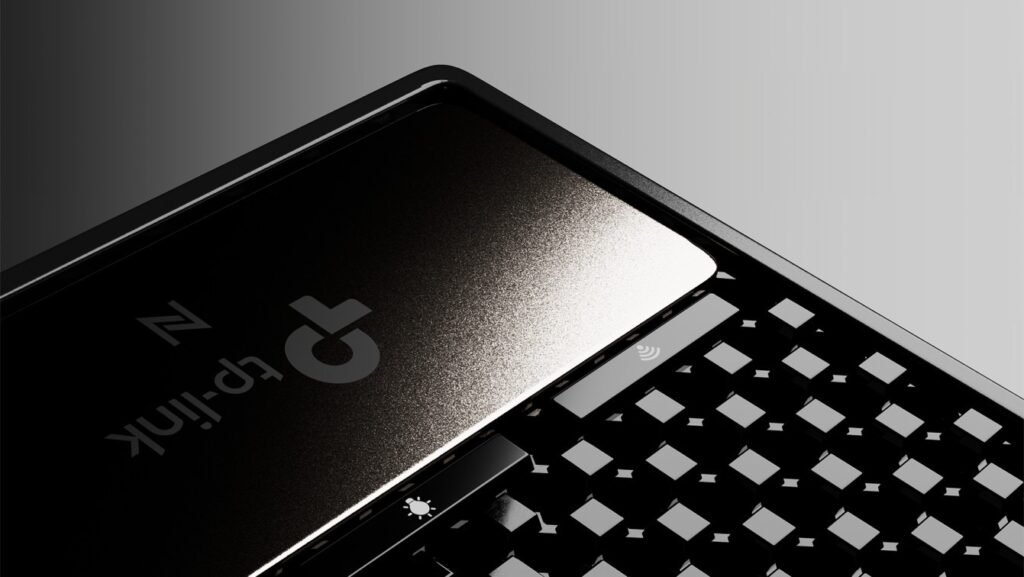
Beyond performance, TP-Link is also positioning Archer 8 as a premium hardware platform. The company said the router features a minimalist architectural form, micro ridge texturing, precision contours, and a soft front-facing emissive light meant to give the device a modern and premium look.
Behind the design, Archer 8 combines thermal engineering, antenna architecture, RF optimization, and AI-assisted network intelligence to support more stable performance across demanding home environments.
Archer 8 is also the first product in TP-Link’s broader Wi-Fi 8 portfolio. The company’s planned lineup includes Deco 8, a Wi-Fi 8 mesh system set for the first quarter of 2027; Roam 8, a Wi-Fi 8 travel router set for the second quarter of 2027; and Wi-Fi 8 range extenders and adapters also planned for the second quarter of 2027.

TP-Link said the portfolio is designed to bring ultra-high reliability, lower latency, and more stable real-world performance across different home networking needs, from flagship routers and whole-home mesh systems to portable travel networking and client connectivity.
Regional availability and final product specifications will vary by market and will be announced closer to launch, the company said.
TP-Link also noted that results are based on its internal lab testing under controlled conditions, and that actual performance may vary depending on client devices, environmental conditions, interference, and network configuration.