About Us
Techxistentialist
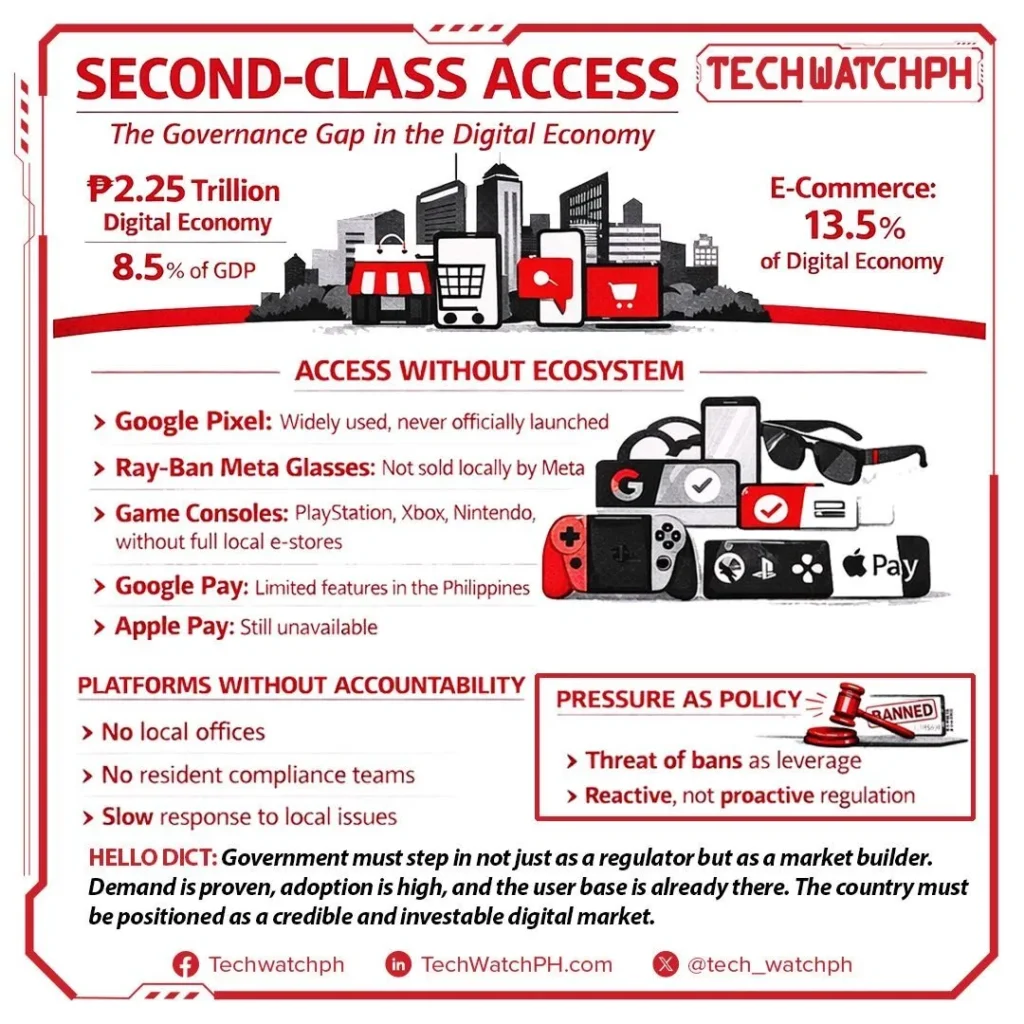
Filipinos are not just online. We are among the most active digital users in the world. We shop, message, stream, and transact at scale, powering a digital economy now valued at ₱2.25 trillion. Yet despite this level of participation, the Philippines continues to operate without the full support, presence, and accountability that typically come with markets of this size.
Data from We Are Social consistently ranks the Philippines among the most active internet and social media users globally, with Filipinos spending more than eight hours online daily and over three hours on social platforms, a level of engagement that translates into real economic weight, with the Philippine Statistics Authority estimating the digital economy at around ₱2.25 trillion, or roughly 8.5 percent of GDP, and e-commerce accounting for about 13.5 percent of that total, firmly placing the country among the region’s most dynamic digital consumer markets. The Philippines is also the social media capital of the world.
Yet despite this scale, a structural gap remains. Filipinos have access to global technology, but not the full ecosystem that typically comes with it.
Access without ecosystem
Filipinos can access almost every major global technology product, but that access often stops at the point of use. The Google Pixel is widely used, yet it has never been officially launched in the local market. Units are brought in through resellers, often without warranty coverage or full network optimization. The Ray-Ban Meta Smart Glasses from Meta Platforms are not officially sold in the Philippines, and the Microsoft Surface remains limited to partner channels, with no strong local support ecosystem.
Gaming makes the gap even more visible. The Nintendo Switch is widely used, yet there is no Philippine region for the Nintendo eShop, forcing users to register under other countries just to purchase digital content. The PlayStation 5 is officially sold, but the Philippines is not treated as a full PlayStation Network region, while the Xbox Series X operates without a dedicated local ecosystem. Millions of Filipino gamers participate in global platforms, but the market itself is not fully recognized within those systems.
Even in payments, the distinction remains. Google Pay is now available in the Philippines, but only in a limited form, primarily supporting tap-to-pay and select financial institutions, while Apple Pay remains unavailable. Access is present, but full ecosystem support is not.
A business decision with broader consequences
This gap is not due to technical limitations. Global technology companies are fully capable of operating in the Philippines, but their level of investment reflects a commercial decision. While the country is large and highly digital, it is also price-sensitive, with fragmented payment systems and regulatory processes that require active engagement. Many companies find it more efficient to serve the Philippines through regional hubs such as Singapore or Hong Kong rather than establish a full local presence.
From a business standpoint, this works. Filipinos continue to adopt and use global platforms at scale. However, the implications extend beyond commerce.
When platforms are present but accountability is distant
Platforms such as X, Roblox, Signal, Telegram, and Meta Platforms are deeply embedded in everyday life in the Philippines. Yet when issues arise, whether related to scams, harmful content, or child exploitation, the absence of a local presence becomes a structural challenge.
Government agencies do not have a direct office to engage or a resident compliance team that can respond immediately within the local context. Instead, concerns are routed through regional or global offices outside Philippine jurisdiction, where response times and priorities may not align with the urgency of local issues.
When pressure becomes the default tool
In the absence of direct engagement channels, the government is left with limited options. Public pressure, including the threat of platform bans, has become a means of compelling a response.
This is not because it is the preferred approach, but because it is often the only available leverage. Without a clear line of engagement, escalation becomes the mechanism for attention. Engagement happens after pressure, not within a structured system.
This also reflects a deeper gap in strategic direction. The Department of Information and Communications Technology has taken visible steps in calling out platforms, but the broader approach remains largely reactive. The focus has been on forcing compliance, rather than building a framework that makes the Philippines an attractive market for long-term platform investment and presence.
From commercial gap to governance issue
The same factors that limit product launches, payment integration, and ecosystem investment also explain the absence of local accountability structures. When platforms are not embedded in the market, they are also less embedded in its responsibilities.
This creates a situation in which Filipinos are among the most active users globally but operate within a system where protection is slower and accountability is harder to enforce.
From a gap to an opportunity
The Philippines is not lacking in demand, users, or digital behavior. These are already established. What is missing is positioning.
At ₱2.25 trillion, the digital economy is already large enough to matter. The level of engagement is already among the highest in the world. These conditions do not need to be built. They need to be leveraged.
This is where government must step in, not just as a regulator, but as a market builder.
The Philippines is, in many ways, low-hanging fruit for global technology investment. Demand is proven. Adoption is high. The user base is already there. What is needed now is to position the country as a credible and investable digital market.
That means moving beyond reactive measures and clearly articulating a national strategy that encourages platform presence, sets expectations for accountability, and provides a stable regulatory environment for long-term investment.
Global platforms invest where there is both scale and clarity. The Philippines already has the scale. What it needs is clarity, and that clarity must be driven by policy.
This should be one of DICT’s strategic roles, which it is not doing: positioning the Philippines as a digital market worth investing in.
(Jocel De Guzman is the Co-Founder of Scam Watch Pilipinas, Founder and President of Truth360 Inc., and ePublisher of TechWatchPH)
Yes, scammers are getting caught — but no one’s talking about it