About Us

CULTURE & CODE
By Joey Briones
For years, we lived with a simple workplace rule: Humans think. Machines obey.
That era is over. Dead. Finished. Archived next to your old Nokia 3310.
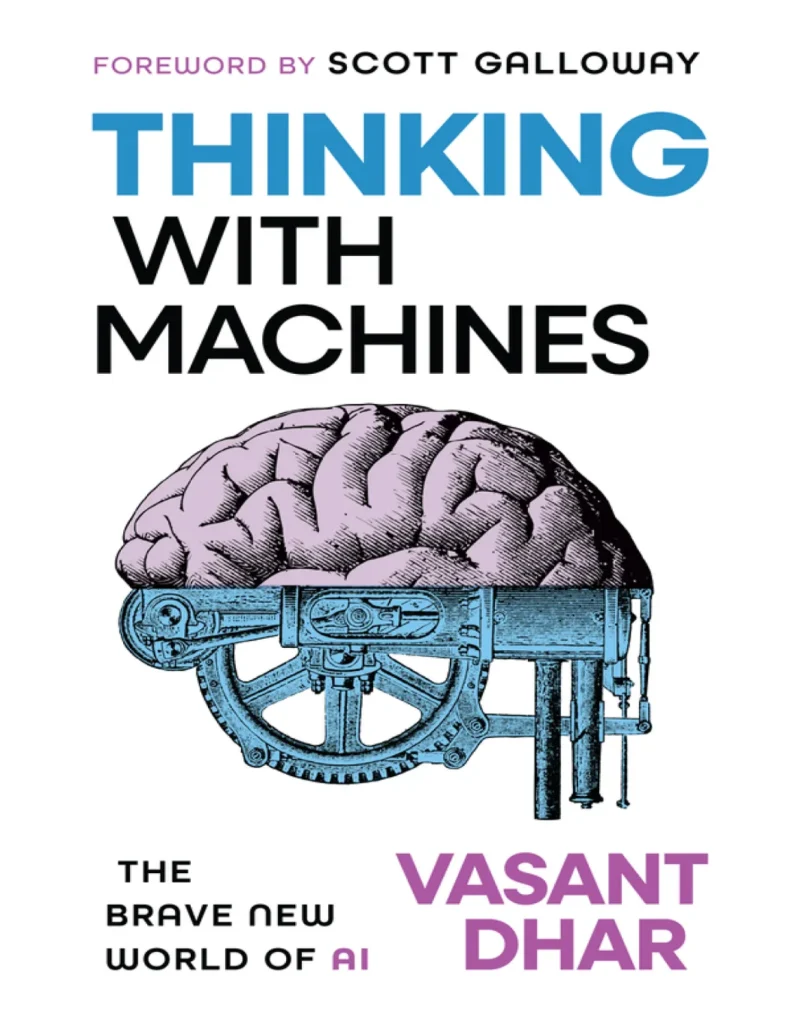
Thinking With Machines (book just released last November 18) by Vasant Dhar makes it clear: We are now entering a world where humans and machines think together — not as rivals, but as cognitive co-workers.
And here’s the plot twist:
The winners in this new world aren’t the ones who “use AI.”
They’re the ones who can do something far more sophisticated:
Leaders who can think with AI, instead of using it like a glorified vending machine for answers.
This is not the age of automation.
This is the age of “co-intelligence”.
AI is not your tool — it’s your new (and very opinionated) colleague
Dhar (a leading global thinker on artificial intelligence and decision science, as well as Professor and former Head of NYU’s Center for Data Science) reframes AI in a way that should be printed on office walls:
AI is not a calculator.
AI is not a faster Google.
AI is not your intern (even though some interns behave suspiciously like ChatGPT).
AI is a second cognitive presence in your workflow:
- It sees patterns faster than you.
- It simulates decisions before you act.
- It spots risks while you’re still finding your glasses.
- It connects dots you didn’t even know existed.
But let’s be honest: AI also has the emotional range of a teaspoon.
It has no context, no conscience, no common sense.
That means the magic happens only when humans and machines think together.
The leadership upgrade: Stop treating AI like a task rabbit
Many leaders still use a 1990s mental model of technology:
“AI = tool to make tasks faster.”
Wrong.
It should be: “AI = cognitive partner that reshapes leadership itself.”
The old question was: “Can AI do this task for me?”
The new leadership question — the Dhar question — is:
“What do humans do after AI does this task?”
That’s the mental upgrade of the decade.
Intelligence Used to Belong to People.
Now It Belongs to Systems.
Dhar’s most powerful idea is deceptively simple:
Intelligence isn’t a person anymore — it’s the system you build.
A team’s performance is no longer determined only by the brilliance of its people.
It’s determined by how well those people collaborate with machine intelligence.
The new unit of work isn’t the individual. It’s not even the team.
It’s the human + machine cognitive loop.
This loop either becomes your unfair advantage . . . or your quiet organizational downfall.
Meta-reasoning: Your new leadership superpower
Forget “strategic thinking.”
Forget “executive presence.”
Forget “influencing without authority.”
The new leadership skill is meta-reasoning — thinking about how thinking happens.
Practically, this means leaders must be able to:
- Understand how AI arrives at its output.
- Know when the model is hallucinating.
- Sense when something is “off”.
- Override the machine with human judgment.
- Provide the ethical, emotional, contextual pieces AI will never have.
In the old world, leaders were rewarded for having answers.
In the new world, leaders are rewarded for knowing when the answers are incomplete.
Culture determines how humans + machines think together
This is the part Dhar doesn’t say explicitly — but it’s obvious: If your culture is weak, your AI will be even weaker.
Because the future workplace needs a culture where:
- people question algorithms without fear;
- learning is continuous;
- feedback loops are fast;
- mistakes are data, not disasters;
- experimentation is normal;
- ethics is intentional.
AI will expose your culture more than any employee survey ever could.
If your leadership team struggles with clarity, accountability, communication, or humility — congratulations, AI will magnify all of it by 10X.
AI doesn’t fix dysfunction. It accelerates it.
The human ddvantage: Meaning (still 100% not automatable)
Dhar is clear about one thing:
AI may generate output, but humans generate meaning.
Machines can compute. But only humans can care.
Machines can recommend actions. But only humans can understand consequences.
Machines can optimize decisions. But only humans can decide what matters.
This is why leadership doesn’t disappear in the age of AI.
It becomes more human, not less.
The real question for modern leaders
Dhar leaves us with a compelling question that should be tattooed on the inside of every leader’s eyelids:
If AI is learning to think, are we learning to think better because of AI?
That — not automation — is the real revolution.
AI isn’t replacing leadership. AI is raising the standard of leadership.
And the next generation of high-performing organizations will be built by leaders who don’t just use machines to accelerate tasks — but use them to expand thinking, deepen judgment, and strengthen humanity.
We are entering the age of shared cognition.
The question is not whether machines will think.
It’s whether we will learn to think with them.