About Us

DECODED: TECH, TRUTH, AND THREATS
By Art Samaniego
In the age of screenshot politics and hyper-fast social media, correcting misinformation matters just as much as HOW you correct it.
Recently, an art card containing false information attributed to the First Lady circulated online. To clarify the situation, the First Lady’s official Facebook page shared the image but unfortunately posted it in full, without altering or watermarking it to clearly show that the content was fake.
The page added a short caption saying “. . . and speaking of FAKE NEWS. . . “welcome to entertainment, Pinoy style” but the warning got buried.
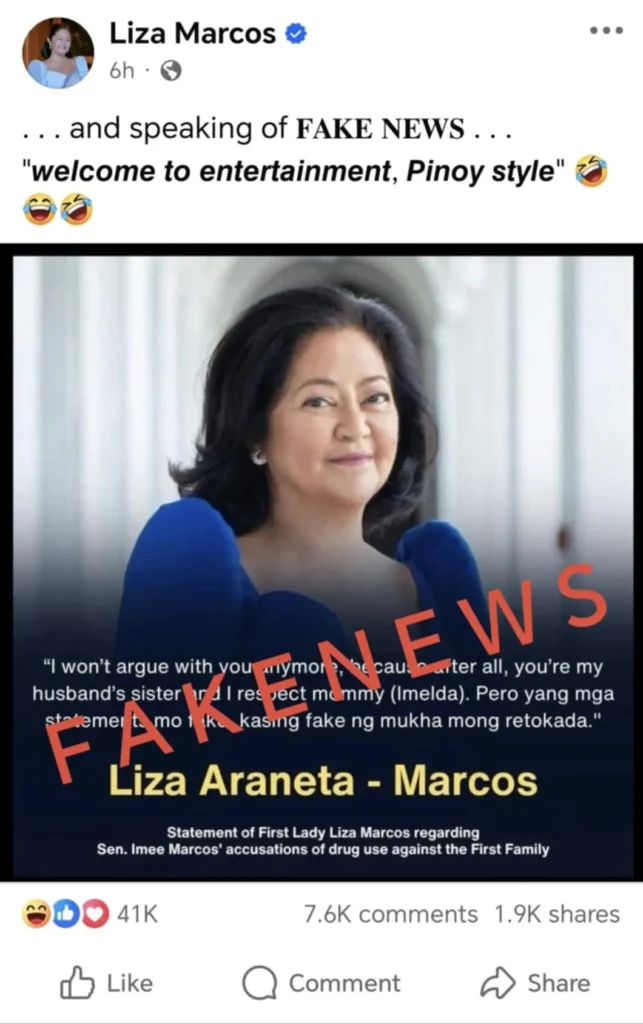
Many users who only glanced at the post or who saw the image out of context assumed it came from the official page itself. This is a perfect example of how quickly an attempt to correct misinformation can unintentionally amplify it.
Why sharing fake content in full is dangerous
- Images spread faster than captions. Most people scroll quickly. They see the image, not the text above it. An unaltered fake art card even in a “debunk” post can still be interpreted as real.
- Screenshots travel without explanations. Users often share images without captions. Once the fake image leaves the original post, the “fake news” disclaimer disappears entirely.
- Official pages carry implicit authority. Anything posted from an official account, even as an example, risks being interpreted as a legitimate release especially by casual readers.
- “Fake news” labels must be unmistakable. A short caption is not enough. The content itself needs visible, embedded clarification. Otherwise, people miss the context.
How to avoid confusion in the future
To prevent this type of misinformation overlap, public figures and official page administrators should adopt safer, clearer practices when debunking fake posts:
- NEVER repost the fake content unchanged. Always modify the image before sharing it. Best practices include: Add a large, diagonal WATERMARK saying “FAKE” or “DISINFORMATION” Add a red border identifying it as fabricated Blurry or crop sensitive parts of the fake image Use side-by-side format: Fake vs. Fact This ensures the fake graphic can never be mistaken for an official release.
- Lead with a clear, unmissable headline. Start the caption with something strong and unmistakable, such as: ⚠️ THIS IMAGE IS FAKE. We are sharing it to warn the public. Make sure the warning appears above the “See More” fold so people see it immediately.
- Use alt-text or the image description tools. FB and other platforms allow descriptive text; use it to clarify: “This is NOT an official art card. It is FAKE and being shown only for public awareness.”
- Avoid posting the fake image as the first photo. If possible, make the first frame a graphic saying “FAKE NEWS ALERT,” and place the fake image in the second slide for context.
- Coordinate with followers and media partners. Clear messaging helps everyone, from supporters to journalists, avoid misinterpretations and misinformation loops.
A reminder for page admins If the goal is to stop disinformation, clarity is crucial. Official pages need to remember: People skim, they don’t read.
Fake images travel far longer than captions. Ambiguous corrections end up helping the hoaxers. The safest way to fight misinformation is to ensure that every correction is loud, clear, and visually unmistakable.
Because in today’s online landscape, even a well-intentioned post can accidentally become part of the problem.