After making headlines for its technology-driven scrutiny of the proposed 2027 national budget, the tech community appears far from finished in its push for greater transparency in government spending.
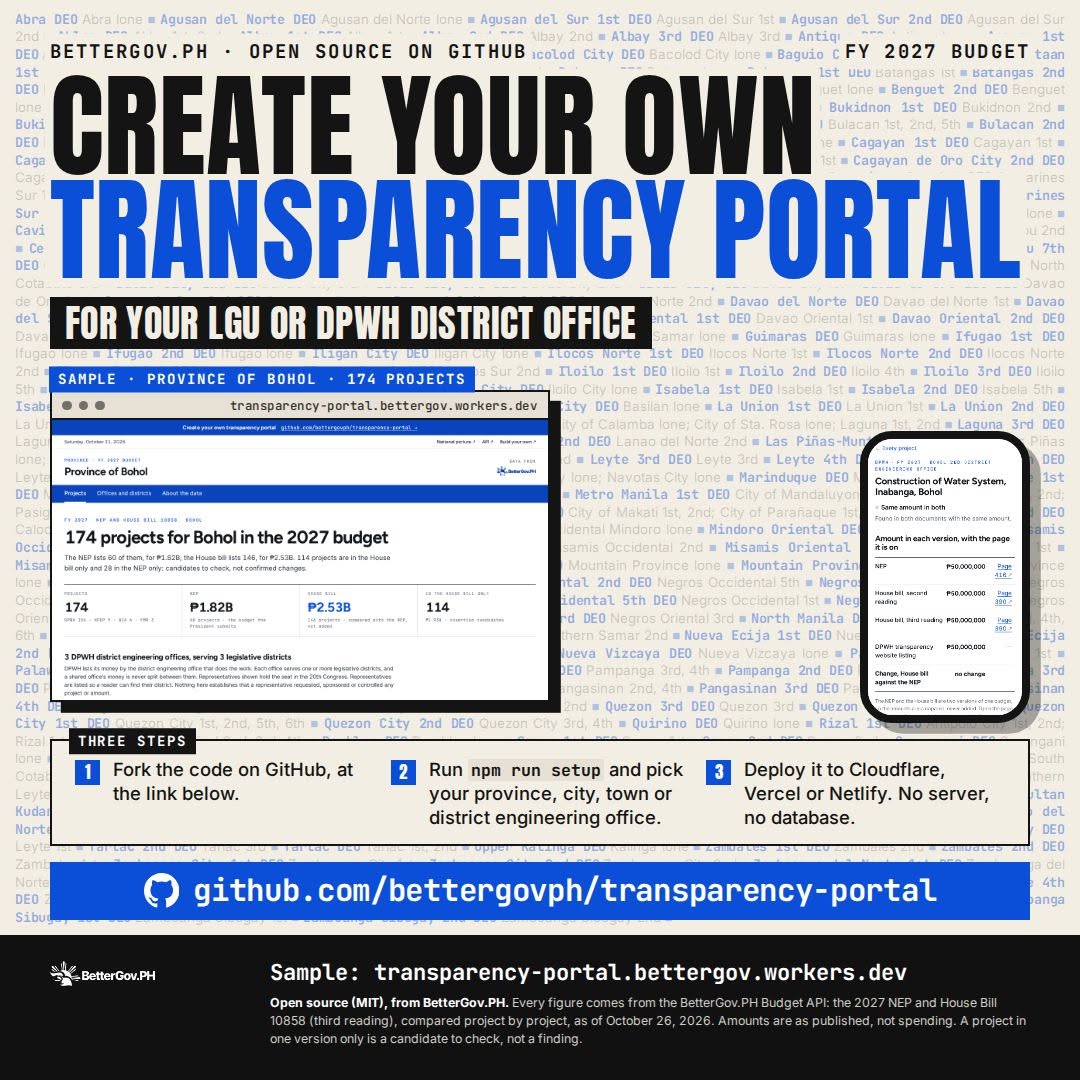
Civic technology group BetterGov.PH is taking its efforts further by introducing a free, open-source tool that allows Filipinos to create their own transparency portals for provinces, cities, municipalities, and Department of Public Works and Highways (DPWH) district engineering offices.
Through these locally focused websites, residents can check which infrastructure projects are proposed for their communities, how much funding has been allocated in different versions of the budget, and whether projects were added or dropped during congressional deliberations.
The initiative follows BetterGov.PH's earlier use of technology to identify discrepancies between the government's original 2027 spending proposal and the version approved by the House of Representatives.
How BetterGov.PH used technology to trace nearly ₱190B in 2027 budget additions
Instead of going through lengthy government budget documents, residents can use these portals to find projects in their communities and check the figures against official records.
"Create your own transparency portal. A new way to contribute," BetterGov.PH founder Jason Torres said in a Facebook post.
Through the tool, users can compare project allocations in the 2027 National Expenditure Program (NEP), or the President's original spending proposal, with those in House Bill 10858, the version approved by the House of Representatives.
Each project entry can also provide links to the exact pages of the source budget documents, allowing residents to verify where the figures came from.
How does the technology work?
Unlike a conventional information website that requires its own database and server infrastructure, BetterGov.PH's transparency portal retrieves information directly from the BetterGov.PH Budget Application Programming Interface (API).
An API allows different software applications to exchange information. In this case, it enables individual transparency websites to obtain budget records from the same data source used by BetterGov.PH's budget monitoring platform.
Because the information comes from a shared source, developers do not have to manually encode every budget project or maintain a separate budget database.
The platform also allows users to search for projects, filter records according to government program, budget comparison status, DPWH office, or reason for inclusion, and download the results as a CSV file for further examination.
Individual project pages show the amounts appearing in each budget version, how corresponding entries were matched, and links to the original PDF pages.
The portal also has an About the Data section explaining how records were selected, which entries were excluded, and the rules used in presenting the information.
How can communities create their own portals?
BetterGov.PH has made the source code available on GitHub, allowing developers to copy and customize the platform for their chosen locality.
According to the project's instructions, developers can obtain the code, run a setup command to select their province, city, municipality, or DPWH district engineering office, and publish the website through hosting services such as Cloudflare, Vercel, or Netlify.
The process involves three steps: copying the code from GitHub, running the setup command to select the locality or engineering office, and deploying the completed portal to a hosting service.
BetterGov.PH has already provided a sample transparency website for the Province of Bohol, showing how budget information can be organized around a particular locality.
The project also includes example configurations for a DPWH district engineering office, Quezon City, and Carmen, Bohol.
transparency-portal.bettergov.workers.dev/?fbclid=IwY2xjawVSpYtleHRuA2FlbQIxMABwZG9mAWJyaWQRMVhIdWR4Yjh6T2tVT1pmb0dzcnRjBmFwcF9pZBAyMjIwMzkxNzg4MjAwODkyAAEfM5bETZWgoAma2SXWJIuwERtfoHiJqptdfCtABdi0pFrU6sLOlMgsap-shxI_aem_ASDjRAAZh9HTBrld5uK5zQ
However, the system has limitations. The API currently identifies DPWH allocations primarily through engineering offices rather than the exact municipality where every project is located.
For municipal portals, some projects are identified through place names appearing in their descriptions, which means certain records may require further verification.
Does a project appearing only in the House bill mean it was inserted?
BetterGov.PH emphasized that differences between budget documents should not automatically be interpreted as evidence of questionable allocations.
A project appearing only in the House-approved bill is a candidate for further checking, not necessarily a confirmed insertion. Similarly, a project appearing only in the NEP does not automatically mean it was removed.
The platform also distinguishes between proposed allocations and actual government spending.
Amounts displayed in the portals represent figures published in the respective budget proposals, not money already released or spent on projects.
To prevent misleading comparisons, the system keeps the NEP and House bill figures separate rather than combining them. It also flags project entries whose matches between documents have not been confirmed.
The portal also avoids assigning shared DPWH engineering office allocations to individual congressional districts, since a single office may serve several districts.
BetterGov.PH said a centralized citizen reporting system is also planned, which would eventually allow users to submit concerns about individual projects through its main budget monitoring website. The feature has not yet been implemented.
For local governments, journalists, civic groups, and residents, the initiative offers another way to examine public spending proposals without having to develop a budget monitoring platform from scratch.
The source code is publicly available through BetterGov.PH's GitHub repository, while a working sample transparency portal is available for communities interested in exploring the platform.
transparency-portal.bettergov.workers.dev/?fbclid=IwY2xjawVSpYtleHRuA2FlbQIxMABwZG9mAWJyaWQRMVhIdWR4Yjh6T2tVT1pmb0dzcnRjBmFwcF9pZBAyMjIwMzkxNzg4MjAwODkyAAEfM5bETZWgoAma2SXWJIuwERtfoHiJqptdfCtABdi0pFrU6sLOlMgsap-shxI_aem_ASDjRAAZh9HTBrld5uK5zQ