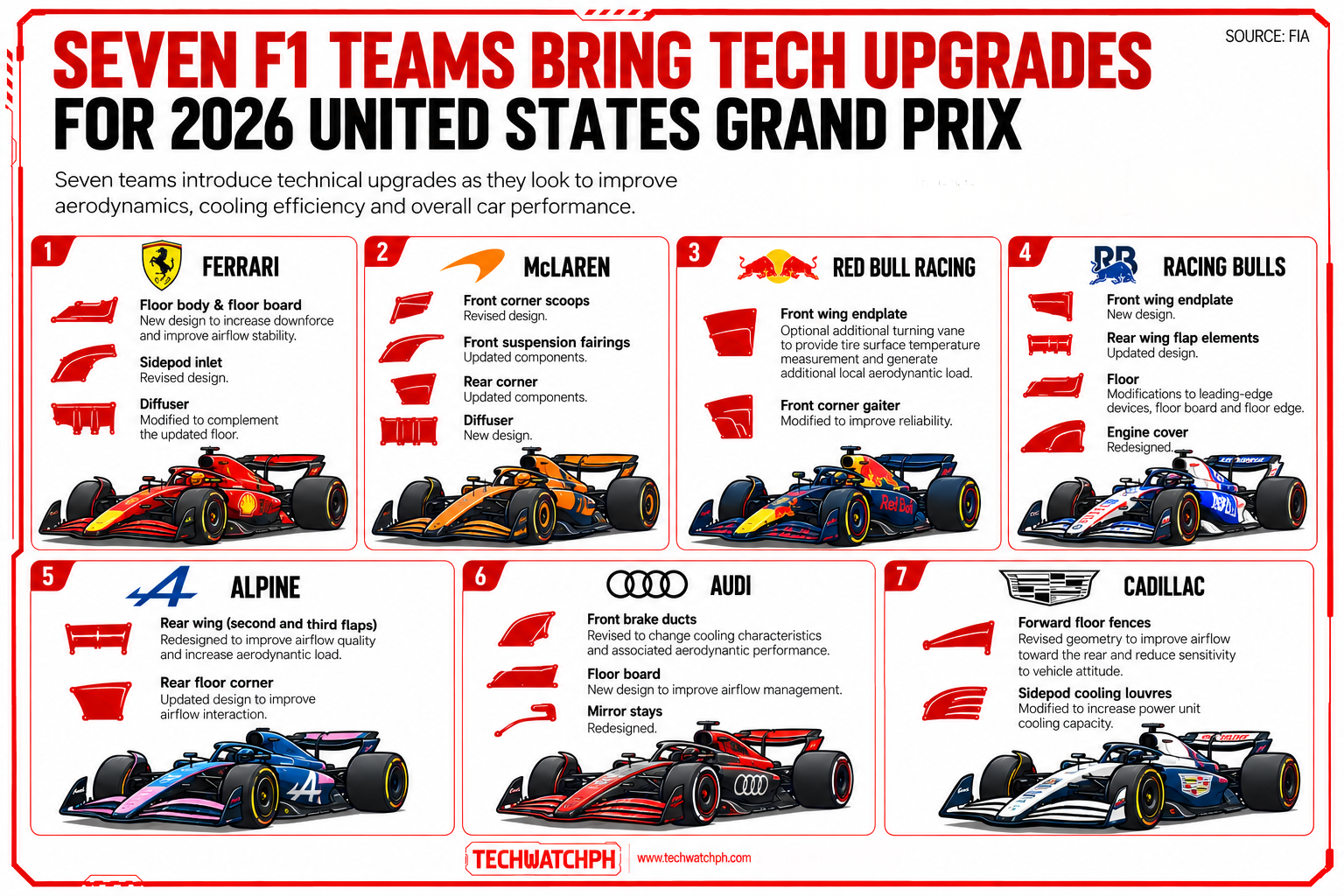
Seven Formula 1 teams have introduced technical upgrades for the 2026 United States Grand Prix in Austin, Texas, as they seek to improve aerodynamics, cooling efficiency, and overall car performance.
According to the Fédération Internationale de l'Automobile (FIA), Ferrari, McLaren, Red Bull Racing, Racing Bulls, Alpine, Audi, and Cadillac have brought modifications to their cars, targeting different areas of performance.
The upgrades range from redesigned floors and wings to improved brake cooling systems and aerodynamic components.
Ferrari introduces major floor upgrades
Ferrari has brought significant changes to its SF-26, including a new floor body and floor board designed to increase downforce and improve airflow stability toward the rear of the car.
The Italian team has also introduced revised sidepod inlets and a modified diffuser to complement the updated floor.
The modifications are intended to improve the car's aerodynamic performance by managing airflow underneath and around the vehicle.
McLaren revises aerodynamic components
McLaren has introduced several aerodynamic improvements to its MCL40, focusing on the front and rear sections of the car.
The upgrades include revised front corner scoops and aerodynamic elements, alongside changes to the front suspension fairings.
The team has also updated the rear corner components and introduced a new diffuser.
According to the FIA, the modifications are designed to improve airflow management and increase aerodynamic load.
Red Bull brings front wing adjustments
Red Bull Racing has introduced two relatively small upgrades for the Austin race.
The first is an optional additional turning vane on the endplate of its recently introduced front wing.
The team said the component is intended to provide a tire surface temperature measurement while also generating additional local aerodynamic load.
Red Bull has also modified the gaiter at the front corners of its car to improve reliability.
Racing Bulls updates wings, floor, and engine cover
Racing Bulls has introduced several changes to its VCARB03, including new front wing endplates and updated rear wing flap elements.
The team has also modified multiple sections of the floor, including the leading-edge devices, floor board, and floor edge.
A redesigned engine cover has also been introduced to work with the updated floor configuration.
The changes focus on improving airflow management and aerodynamic performance across different sections of the car.
Alpine focuses on rear wing performance
Alpine has introduced modifications to the rear wing of its A526, redesigning its second and third flaps.
The adjustments are intended to improve airflow quality around the rear wing and increase overall aerodynamic load.
The team has also updated the rear floor corner to improve airflow interaction around that section of the car.
Audi modifies brake cooling and airflow systems
Audi has introduced aerodynamic and cooling-related improvements to its R26.
The German team has revised its front brake ducts to change their cooling characteristics and associated aerodynamic performance.
Audi has also introduced a new floor board aimed at improving airflow management, alongside redesigned mirror stays.
These modifications are intended to improve how air moves around the vehicle while addressing cooling requirements.
Cadillac improves floor aerodynamics and cooling
Cadillac has introduced updates to its MAC-26 for its home Grand Prix.
The team has revised the geometry of its forward floor fences to improve airflow toward the rear of the car and reduce sensitivity to changes in the vehicle's attitude.
Cadillac has also modified the cooling louvres on the upper section of its sidepods to increase power unit cooling capacity.
The changes are intended to improve aerodynamic consistency and cooling performance.
Technology behind F1 performance
The technical upgrades highlight how Formula 1 teams continue to refine their cars through aerodynamic engineering and cooling-system improvements.
Components such as floors, diffusers, wings, and brake ducts play important roles in managing airflow, generating downforce, and controlling temperatures.
While the seven teams have targeted different areas of their cars, the FIA's technical disclosures identify improved airflow management, aerodynamic load, cooling, and reliability as the primary objectives of the modifications.