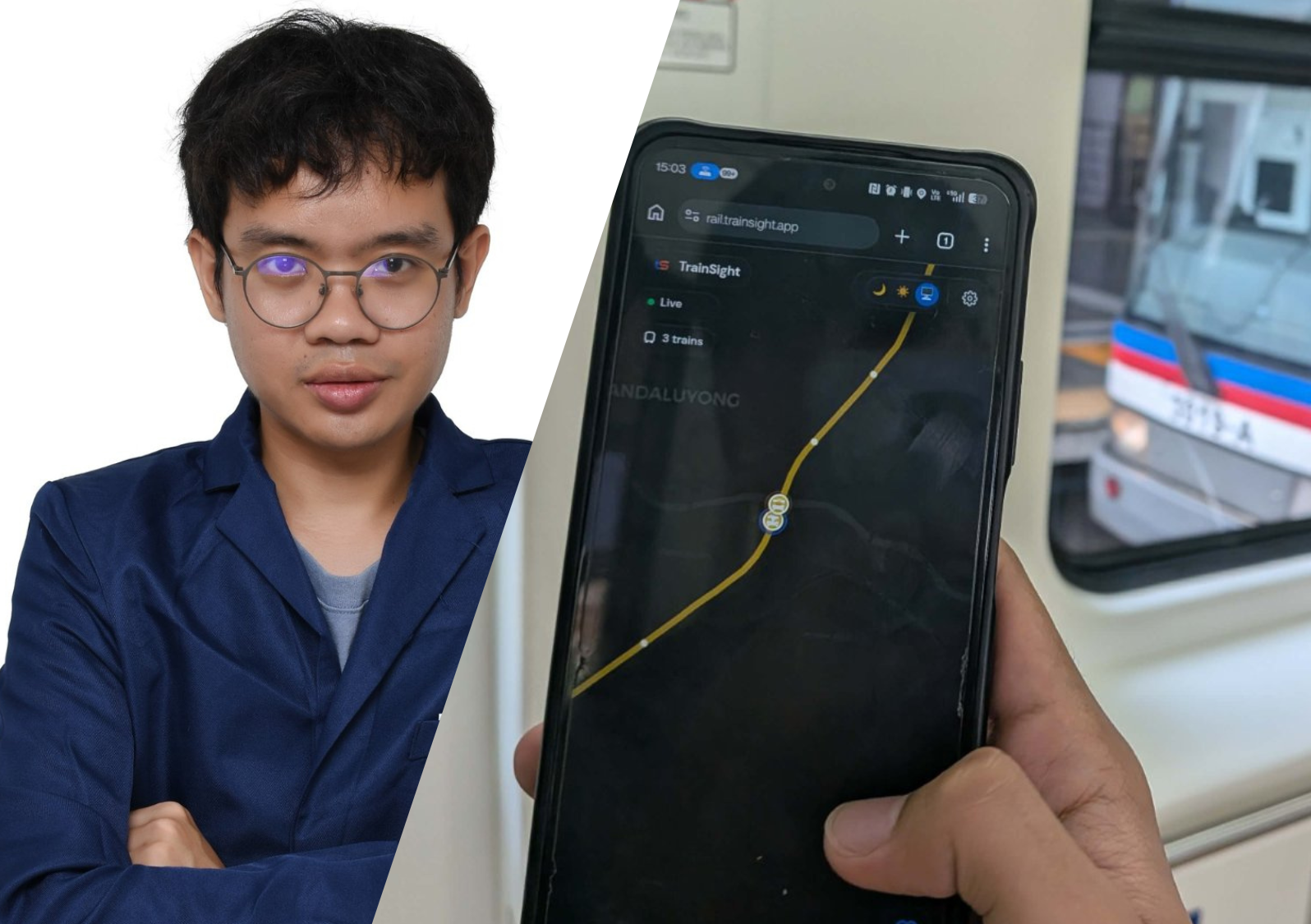
Waiting for a train without knowing when it will arrive could soon become less frustrating for Filipino commuters, as a group of local developers works on TrainSight, an application designed to track train movements and help passengers identify possible service disruptions.
The idea came from Filipino developer Rhey Crusem, who experienced firsthand the uncertainty of waiting for a train while commuting daily from Cavite to Mandaluyong City for his previous job.
Crusem regularly relied on the Metro Rail Transit Line 3 (MRT-3) and Light Rail Transit Line 1 (LRT-1), which he considered the fastest and most efficient transportation options for his route.
However, an unexpected service disruption left him waiting for approximately 25 to 30 minutes on a station platform before passengers were informed that a train had stopped somewhere along the railway line.
Coincidentally, Crusem was using FlightRadar24, an application that allows users to monitor aircraft movements in real time, when an idea came to mind.
What if commuters could also track trains and determine whether they were moving normally, traveling slowly, or had stopped for an extended period?
That question eventually led to the development of TrainSight.
Crusem began building a prototype and testing it along the railway network, carrying his laptop during trips and using it as a temporary server to collect data.
He continuously improved the application's tracking logic based on actual railway conditions, including signal noise and other factors affecting location accuracy.
The project took another step forward in December 2025 when Crusem reached out to fellow developer
Clyde Sanmig Corpuz , who had independently developed hardware capable of supporting the tracking system.
READ:
techwatchph.com/article/a-fresh-graduate-engineers-idea-that-could-change-how-filipinos-experience-the-train
Although Crusem had initially planned to develop his own hardware, he decided to collaborate with Corpuz to integrate the existing technology into TrainSight.
The partnership enabled the team to incorporate GPS data transmission into the application, laying the groundwork for tracking devices that could eventually be installed aboard trains.
Under the proposed system, commuters would be able to monitor train movements through the application, helping them determine whether trains are moving, slowing down, or remaining stationary.
However, the project is still under development, and the developers have yet to announce when the application will become publicly available.
Crusem said the team is currently working on mass-producing the GPS tracking devices, with procurement and manufacturing expenses being funded by the developers themselves.
The project has also received support from Railfans of the Philippines, a local community of railway enthusiasts that has provided information and insights into railway operations.
Their contributions have helped the development team better understand the country's railway system and refine TrainSight's features.
The team has since expanded to include Pat Diaz, who oversees frontend development, and Gene Gulanes, a developer and railway enthusiast who also contributes to the application's interface.
Once developed and deployed, TrainSight is intended to give commuters greater visibility into train movements, particularly during unexpected service interruptions.
For now, the developers are continuing their work on the hardware and application as they pursue their goal of bringing train-tracking technology to Philippine railways.