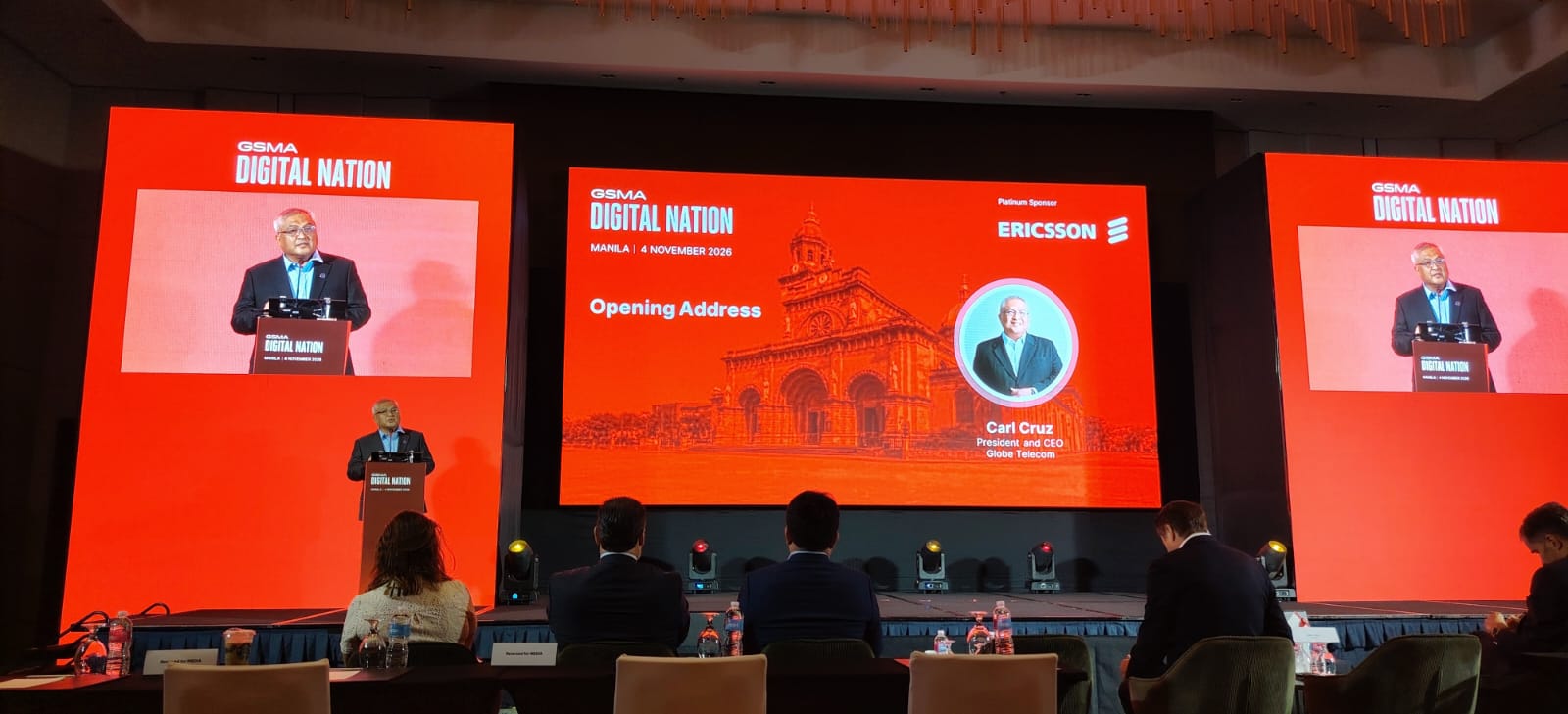
As more Filipinos rely on digital payments, online services and internet connectivity for their daily needs, Globe is calling for stronger collaboration between government and industry to protect users from scams, improve network reliability and prepare the country for an artificial intelligence (AI)-driven economy.
Globe President and CEO Carl Cruz emphasized the importance of digital trust, connectivity and responsible technology adoption during his opening address at the GSMA Digital Nation Summit Manila 2026.
Organized by the GSMA under the theme “Building the Philippines’ Digital Future: Anchoring Trust to Accelerate Value,” the summit gathered representatives from the Department of Information and Communications Technology (DICT), National Privacy Commission (NPC), Cybercrime Investigation and Coordinating Center (CICC), and private sector organizations.
Cruz identified three priorities for the country's digital development: safer digital participation, measurable benefits from advanced connectivity and readiness for an AI-driven economy.
“Trust gives people the confidence to participate, businesses the confidence to invest, and industries the confidence to innovate,” said Cruz. “Technology should strengthen our ability to make decisions and deliver better services. It should never diminish our responsibility for the outcomes.”
Protecting Filipinos from digital scams
With more transactions and essential services moving online, Globe emphasized the need for stronger safeguards to help Filipinos protect their personal information and conduct digital transactions safely.
Discussions at the summit focused on scam prevention, consumer protection and secure digital government services, including the use of open application programming interfaces (APIs) to support identity verification and fraud detection.
Globe highlighted the importance of coordinated security measures among telecommunications companies, digital platforms and financial institutions to address online fraud.
The company also emphasized public education through the Philippine chapter of the Global Anti-Scam Alliance to help users recognize potential scams and make safer decisions online.
Beyond cybersecurity, Globe called for closer coordination among telecommunications companies, power providers and government agencies to strengthen disaster preparedness and improve network restoration.
The company cited its investments in network redundancy, restoration capabilities and satellite-to-mobile connectivity as part of efforts to keep communities connected when traditional communications infrastructure is disrupted.
Preparing Filipinos for an AI-driven economy
Globe also emphasized the importance of preparing businesses and workers for emerging technologies, particularly AI, 5G, cloud computing and edge computing.
Summit discussions explored how these technologies could improve healthcare delivery, manufacturing operations and logistics services, while identifying the infrastructure, partnerships and skills needed for broader adoption.
For businesses, stronger connectivity and AI adoption could help improve efficiency and service delivery, while workers may benefit from developing skills needed in an increasingly digital economy.
Globe said sustained investments in digital infrastructure and emerging technologies remain essential to meeting the country's growing digital needs.
Representatives from Globe-backed 917Ventures, DICT, PLDT/Smart, DITO, ACEN Renewables, Ericsson, Microsoft and other organizations also participated in discussions on strengthening the country's digital economy.
Globe reiterated its commitment to working with government and industry partners to expand connectivity, improve network reliability and strengthen digital safeguards, helping more Filipinos access essential services, conduct transactions safely and benefit from technological advancements.