DATE
Loading...
TIME
Loading...
About Us

For most of history, building a team required authority.
You needed a budget, approved headcount, recruitment, an organizational structure — and usually a management title.
Artificial Intelligence is beginning to change that.
Imagine arriving at work with your own researcher, analyst, writer, project coordinator, executive assistant, strategist, and specialist adviser. They can work simultaneously, operate at extraordinary speed, and increasingly move beyond simply answering questions toward actually executing work.
Eventually, an AI Chief of Staff might coordinate many of these digital capabilities on your behalf.
You may still be one employee. But increasingly, you may no longer be working alone.
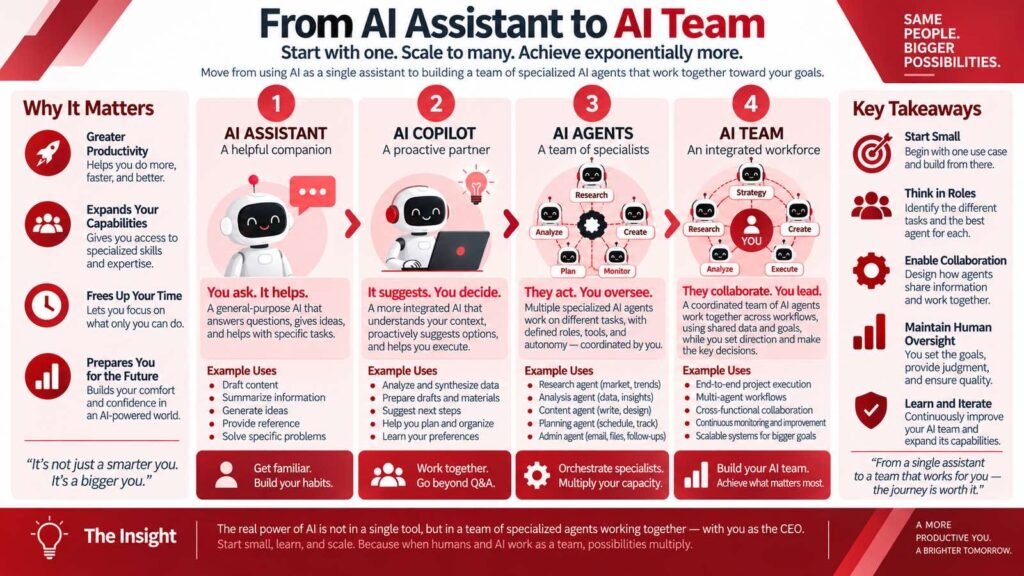
This is the next step beyond simply using ChatGPT, Copilot, Gemini, or another AI assistant. As AI becomes more agentic, we are beginning to move from using AI, to delegating work to AI, and eventually to orchestrating teams of specialized artificial capabilities.
That creates a very different challenge. Having access to AI does not mean we know how to organize it, just as having more people does not automatically create a high-performing team.
Perhaps the next generation of AI literacy, therefore, will be less about becoming better at prompting machines and more about becoming better at designing work around them.
Welcome to your Personal AI Operating Model.
From AI Assistant to AI Team
Most of us still interact with AI through what is essentially an assistant model. We ask a question, AI responds. We provide another instruction, AI produces another output. The human remains the primary coordinator of everything that happens.
That alone can create enormous productivity. But agentic AI introduces something fundamentally different.
Instead of one general-purpose assistant waiting for instructions, imagine specialized AI capabilities working around you: a Research Agent gathering information, an Analytics Agent finding patterns, a Content Agent drafting materials, a Coordination Agent tracking actions, a Strategy Agent challenging assumptions, and perhaps an AI Chief of Staff orchestrating work across them.
The evolution might look something like this:
AI as Tool → AI as Assistant → AI as Agent → AI as Team
And the human role evolves with it:
User → Collaborator → Delegator → Orchestrator
That distinction matters because access to AI will eventually become less differentiating. If everyone has increasingly capable AI, advantage may shift toward how effectively we organize and orchestrate the intelligence available to us.
But there is a trap.
If our first instinct is simply to create agents for everything we currently do, we may end up automating fragments of an operating model that was never particularly good in the first place. We might produce reports nobody really needs faster, accelerate approvals that shouldn’t exist, or automate tasks inside workflows that should have been redesigned entirely.
So perhaps the first rule of building a Digital AI Team is counterintuitive:
Don’t start with AI. Start with the work.
And understanding the work requires a sequence of increasingly deeper questions.
1. Systems Thinking — Understand the Whole
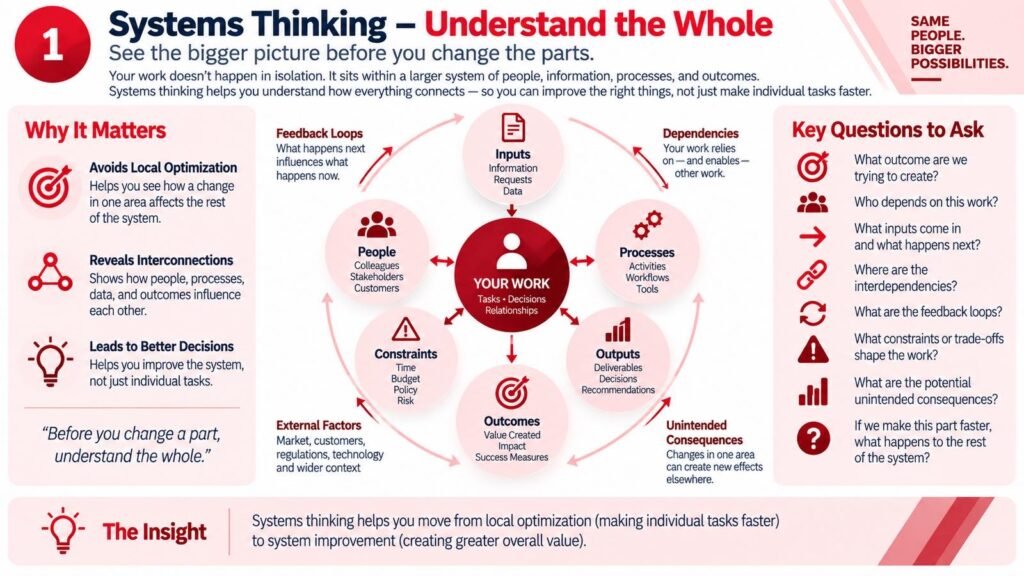
Before asking what AI can automate, step back and ask what the system is actually trying to accomplish.
What outcome are you trying to create? Who depends on your work? What inputs enter the system? What happens downstream? Where are the dependencies, constraints, feedback loops, and unintended consequences?
This is where Systems Thinking becomes essential. It forces us to see an activity not as an isolated task, but as part of a larger system of value creation.
Suppose AI allows a manager to generate ten detailed reports in the time previously required to produce two. On the surface, that looks like a fivefold productivity improvement. But what if those ten reports create more reading, more questions, more meetings, more approvals, and ultimately more work for everyone downstream?
The task became more efficient. The system may have become less efficient.
AI makes this kind of local optimization remarkably easy. We can make almost any individual activity faster without necessarily making the overall outcome better.
Systems Thinking therefore forces us to begin with a more important question:
Are we making a task faster — or are we making the system better?
Once we understand the whole, we can start taking it apart.
2. Task Deconstruction — Understand the Work
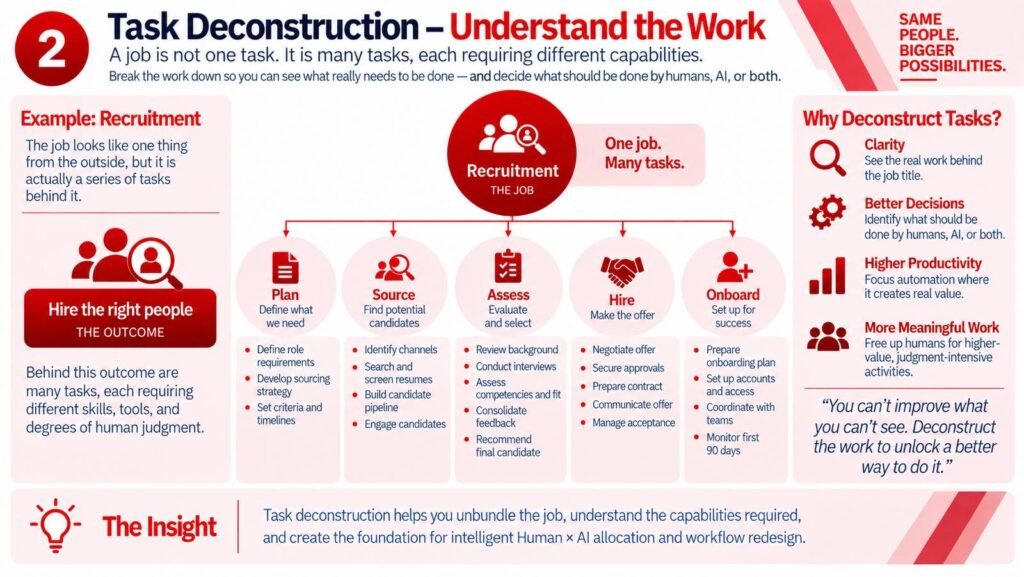
A job may look like one thing from the outside, but underneath it sits dozens — sometimes hundreds — of activities requiring very different kinds of capability.
Consider recruitment. We casually describe the outcome as “hire the right person.” But beneath that outcome are many activities: define requirements, develop sourcing strategies, identify candidates, screen résumés, schedule interviews, conduct assessments, gather feedback, compare candidates, make recommendations, negotiate offers, and onboard the hire.
Even something as apparently singular as interviewing a candidate can be broken down further: prepare questions, gather evidence, probe inconsistencies, evaluate responses, assess potential, compare observations, document findings, and exercise judgment.
AI does not necessarily have the same role in every one of those activities.
This is why Task Deconstruction must come before automation. We need to understand what the work actually consists of before deciding which parts require human creativity, context, relationships, empathy, judgment, or accountability — and which can be augmented, delegated, or executed by AI.
This connects directly to something I explored in my previous Culture & Code article, The End of the Job Description. The traditional job is essentially a bundle of tasks assigned to one human being. AI gives us the opportunity to unbundle that work and ask a more useful question:
For each part of the work, who — or what — is actually best equipped to perform it?
But knowing the individual tasks still isn’t enough. Work is not simply a collection of activities.
Work . . . flows.
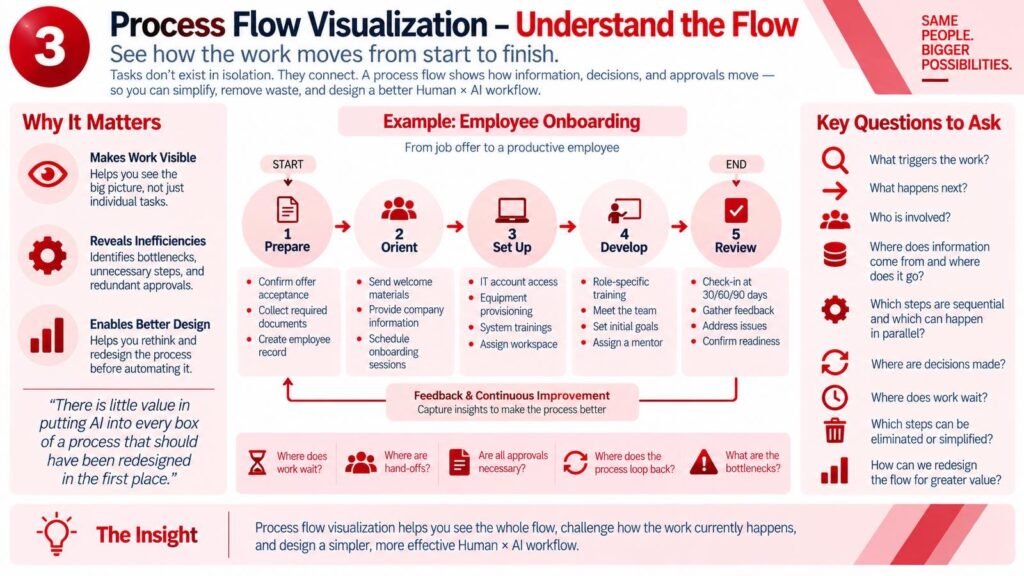
3. Process Flow Visualization — Understand the Flow
Once we understand the pieces, we need to see how they connect.
What triggers the work? What happens next? Where does information originate? Where does it move? Which activities must happen sequentially, and which can happen simultaneously? Where are decisions made? Where does work wait? Where are approvals required? Where are the handoffs? And where does the process loop back because something has gone wrong?
This is where Process Flow Visualization becomes powerful. A process map reveals something a list of tasks cannot: the architecture through which work moves.
And that matters because one of the easiest mistakes in AI transformation is to automate every box in an existing process without questioning whether all those boxes should still exist.
Imagine a workflow containing twelve steps, five approvals, three handoffs, and two reports. AI might make every one of those activities faster. But perhaps the better Human × AI workflow has six steps, one approval, and no report at all.
There is little value in putting AI into every box of a process that should have been redesigned in the first place.
Process Flow Visualization, therefore, isn’t merely about documenting how work happens today. Its real value is making the existing system visible enough that we can challenge how it should work tomorrow.
Only then are we ready to decide where humans and AI actually belong.
4. Human × AI Allocation — Determine the Optimal Performer
Interestingly, this is where many AI conversations begin.
I think it should come fourth.
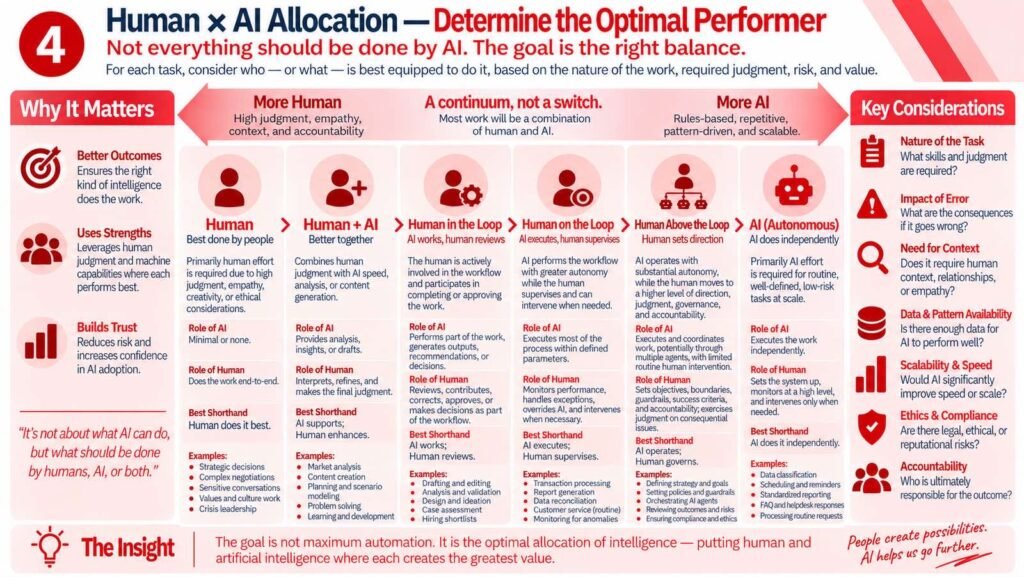
Only after understanding the system, deconstructing the work, and visualizing the flow can we intelligently determine who — or what — should perform each part.
Some work should remain primarily Human. Some will become Human + AI. Some can increasingly be AI-led with humans checking or supervising. And some may eventually be performed autonomously by agents operating within clearly defined boundaries.
This creates a continuum we have explored in previous Culture & Code articles:
Human → Human + AI → Human-in-the-Loop → Human-on-the-Loop → Human-Above-the-Loop → Autonomous AI
The goal, however, should not be to move everything as far toward AI as technologically possible. That would confuse automation with transformation.
The better question is not simply “Can AI do this?” It is “Who or what should do this?”
That decision needs to consider the nature of the task, required judgment, consequences of error, need for context, human relationships, ethics, accuracy, speed, scalability, economics, and accountability.
A machine may be technically capable of performing an activity and still not be the optimal performer. Equally, a human may have performed an activity for decades simply because no viable alternative previously existed.
That is why I prefer the language of Human × AI Allocation rather than automation.
The goal is not maximum automation. It is the optimal allocation of intelligence.
Once that allocation becomes clear, we can finally start designing the Digital AI Team.
5. Agentic Workflow Design — Redesign the System
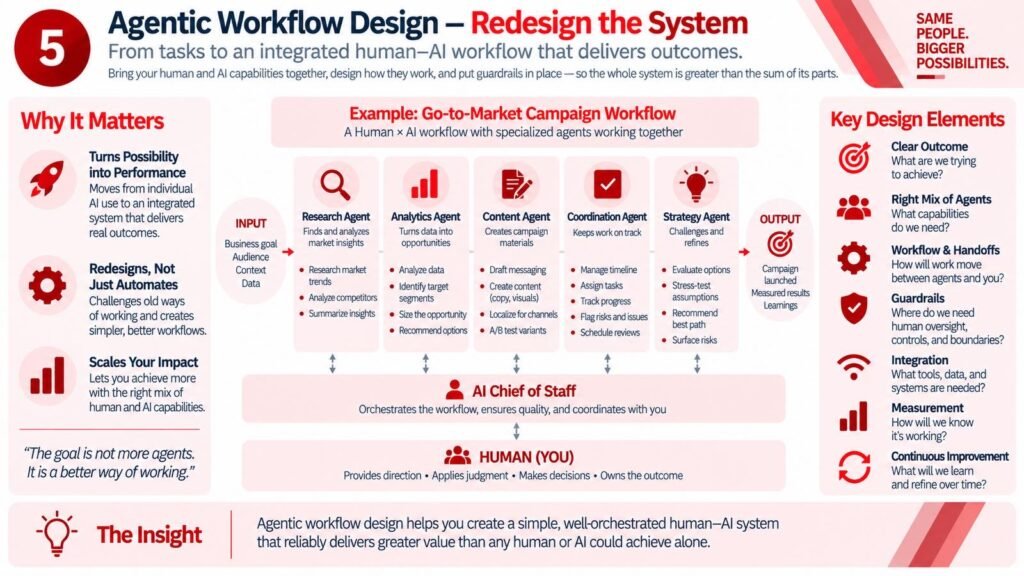
Only now should we start building agents.
Perhaps your work requires a Research Agent to gather and synthesize information, an Analytics Agent to examine data and identify patterns, a Content Agent to translate ideas into drafts and presentations, a Coordination Agent to track commitments and follow-through, and a Strategy Agent to develop scenarios and challenge assumptions.
Perhaps above them sits an AI Chief of Staff that coordinates work across the system.
But simply having six agents does not mean you have a Digital AI Team. Six disconnected agents are still six disconnected tools.
The real value emerges when we design how work moves between them.
Research feeds analysis. Analysis generates options. Another agent challenges assumptions. Recommendations reach the human. The human applies context and judgment. Approved decisions move into execution. Outcomes are monitored, and what happens next feeds back into the system.
Now something important has changed.
We are no longer simply prompting AI.
We are designing work.
And once specialized artificial capabilities begin working together around human objectives, judgment, and accountability, we have crossed from using AI tools into something much closer to an operating model.
The Personal AI Operating Model
This is where all five disciplines come together.
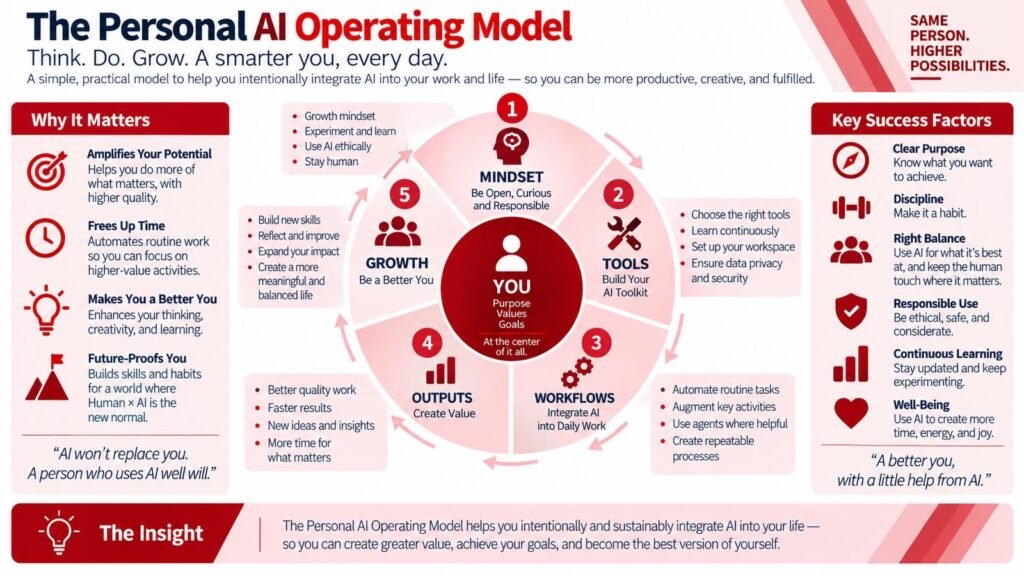
A Personal AI Operating Model is not simply a collection of AI applications, prompts, or agents. It is the architecture through which you organize human and artificial intelligence around the outcomes for which you are accountable.
It begins with five deceptively simple questions:
And underneath that operating model sits the design discipline we have just followed:
Systems Thinking → Task Deconstruction → Process Flow Visualization → Human × AI Allocation → Agentic Workflow Design
One describes the architecture of your Personal AI Operating Model. The other describes the method for designing it.
Together, they move us beyond the idea of simply “using AI better.”
They ask us to start organizing intelligence.
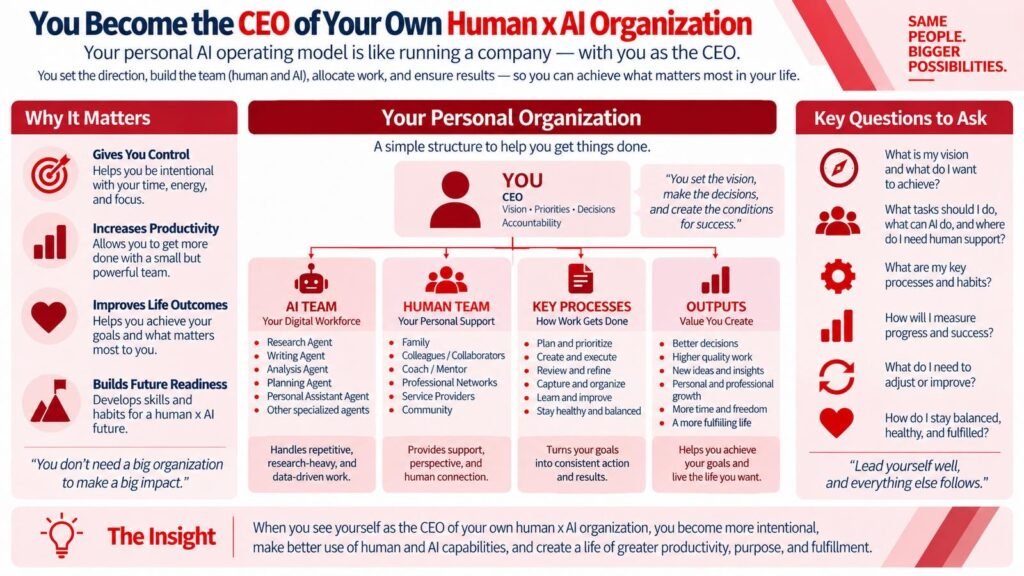
You Become the CEO of Your Own Human x AI Organization
Something interesting happens once you begin working this way.
You stop behaving merely like an AI user and begin behaving more like an organization designer.
You define outcomes. Allocate work. Provide context. Establish standards. Design handoffs. Review performance. Set decision boundaries. Manage exceptions. Decide when humans need to intervene. Identify missing capabilities. And ultimately remain accountable for what the system produces.
These are remarkably similar to the responsibilities involved in running an organization.
Except the organization now exists partly around you.
This connects with another idea I explored in The Great Management Rewrite: Span of Intelligence — the total human and artificial capability one leader can effectively orchestrate toward an outcome.
Increasingly, that idea may apply even to people who aren’t formal managers.
An analyst with no direct reports could orchestrate several AI agents. An entrepreneur could command research, analytics, marketing, finance, and administrative capabilities that once required a small corporate staff. A consultant could build an entire research, analysis, content, and project-management system around oneself. A manager could simultaneously lead a human team and an expanding digital one.
That suggests something more profound than another productivity hack:
In the Agentic Enterprise, organization design may no longer be something only CEOs and HR leaders do. Every knowledge worker may eventually need to become an organization designer.
And perhaps every knowledge worker also becomes, in some small way, the CEO of a digital organization built around their own work.
Don’t Build an Army of Agents Yet
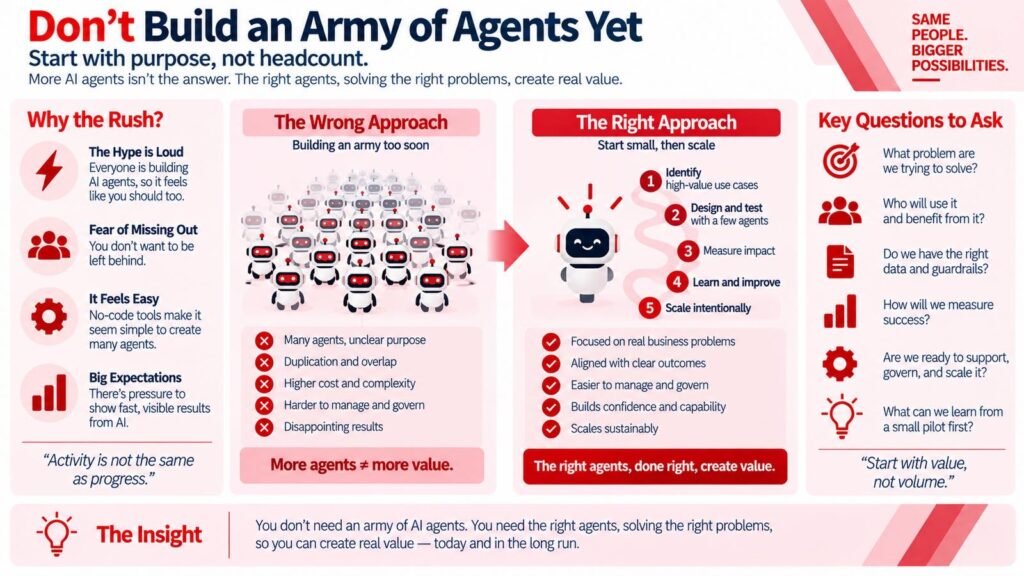
There is, however, an obvious temptation: to equate sophistication with the number of agents we create.
If five agents are useful, ten must be better. If ten are good, twenty must be transformational.
Not necessarily.
A badly designed organization does not become good simply because it hires more employees. Neither does a badly designed Personal AI Operating Model become better simply because it contains more agents.
Too many agents can create duplicated work, conflicting outputs, unnecessary handoffs, excessive AI consumption, unclear accountability, and eventually something we should probably recognize from our human organizations: digital bureaucracy.
The objective should therefore not be to create the largest Digital AI Team possible. It should be to create the simplest combination of human and artificial capability capable of reliably producing the outcome you need.
This is precisely why Systems Thinking comes first and Agentic Workflow Design comes last.
Design the work before you design the workforce.
Otherwise, we risk recreating all the complexity of our existing organizations — only this time at machine speed.
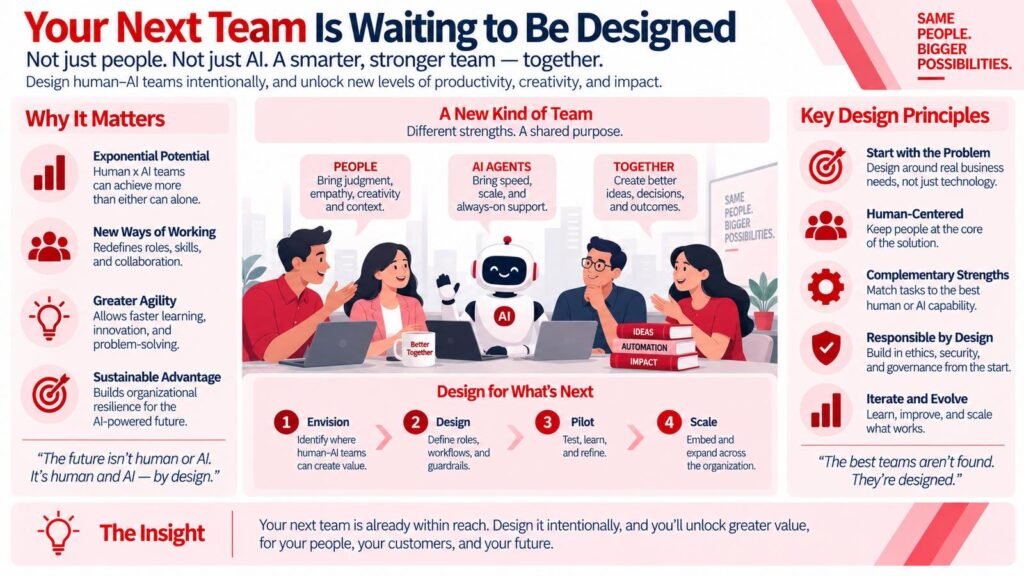
Your Next Team Is Waiting to Be Designed
For most of history, building a team required organizational authority. You needed budget, headcount, hiring approval, and usually a sufficiently senior position.
AI is beginning to democratize that capability.
A young analyst, entrepreneur, consultant, HR professional, manager, or executive may increasingly be able to assemble capabilities that once required several people — or perhaps an entire department.
But access to those capabilities will not automatically create advantage. As AI becomes ubiquitous, the differentiator may increasingly be the ability to organize intelligence around work: to understand the system, deconstruct the tasks, visualize the flow, determine the optimal Human × AI allocation, and redesign the workflow around both.
And throughout all of this, one thing remains distinctly human: accountability for the outcome.
Perhaps that is where the next evolution of AI literacy is taking us.
We started by learning how to prompt AI. Then we learned how to work with AI. Now we may need to learn how to organize AI — how to build, manage, and govern digital capabilities around the work we are responsible for delivering.
For the first time, millions of people may soon have access to something that historically belonged mainly to managers and executives: the ability to assemble a team around themselves.
The question is whether we will merely collect AI tools — or learn how to turn them into an organization.
Because the next generation of knowledge workers may not simply use Artificial Intelligence.
They may each learn to lead an organization of it.