DATE
Loading...
TIME
Loading...
About Us

Southeast Asian leaders were urged to place people at the center of the region’s preparations for increasingly autonomous artificial intelligence systems as ASEAN strengthens its talent pool and digital capabilities.
Rhea Luz Valbuena, executive director of the School of Computing and Information Technologies of Asia Pacific College, made the call during the session “Trust, Talent, and Sovereignty: Building ASEAN’s Human Advantage for the Agentic AI Era” at the official launch of the ASEAN CXO Association in Singapore on July 7 and 8, 2026.
The panel discussed ASEAN’s readiness for Agentic AI, which refers to AI systems capable of reasoning, planning, collaborating, and performing tasks on behalf of people with limited human intervention.
The discussion was attended by Valbuena, Global AI Ambassador Teck Kheong Looi, Prof. Ir. Dr. Mohd Fadhil of Universiti Teknologi Malaysia, AIVERSECITY founder Gordan Vong, Numun Capital partner Jayren Teo, and Artificial Intelligence International Institute founder Dr. James Ong, who served as moderator.
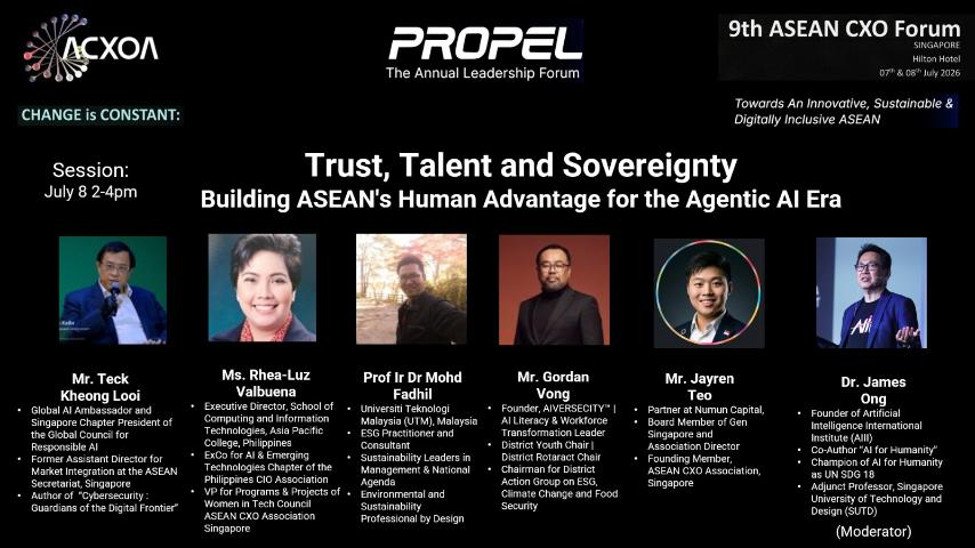
The participants shared insights based on their respective areas of expertise, including responsible AI, education, sustainability, workforce transformation, investment, and regional collaboration.
Representing the Philippine education sector and the country’s chief information officer community, Valbuena said discussions about AI should begin with one question: “How can AI make humans better?”
She said organizations should move beyond viewing AI solely as artificial intelligence and instead embrace it as “augmented intelligence,” or technology that strengthens human capabilities rather than replaces people.
Valbuena also serves as an executive committee member of the AI and Emerging Technologies Chapter of the Philippine CIO Association.
She said future-ready professionals must understand how AI agents reason, how memory and context influence their decisions, and how multiple AI systems collaborate.
Ethical principles, she added, must remain central to the development and deployment of AI.
Valbuena said these concepts are already being introduced to students as educational institutions prepare graduates for workplaces where people are expected to work alongside intelligent systems.
She also emphasized that ASEAN’s long-term competitiveness would depend on its ability to develop AI-ready citizens by upskilling and reskilling professionals, educators, executives, and government leaders.
Valbuena promoted the “AI READY” framework, which stands for Responsible AI, Education, Adoption, Digital Infrastructure, and Youth and Workforce Empowerment.
Philippine Chief Information Officer Association Chair and President Mel Migriño, who also serves as president of the Women in Technology Council of the ASEAN CXO Association, said building an AI-ready workforce would require cooperation among schools, businesses, technology leaders, and government institutions.
“Building an AI-ready workforce requires more than teaching people how to use new tools. We must develop professionals who understand their responsibilities, recognize the risks, and know how to use AI in ways that create meaningful value for organizations and society,” Migriño said.
She added that PCIOA would continue supporting capability-building programs that help institutions and professionals understand emerging technologies and adopt AI responsibly across industries.
On AI sovereignty, Valbuena cited Philippine initiatives such as the National AI Strategy Roadmap, the National AI Center for Research and Innovation, and other government-led programs aimed at strengthening the country’s AI ecosystem.
However, she said AI capability should not be developed in isolation.
“ASEAN has an incredible opportunity to collaborate—not only in technology, but more importantly in developing talent, advancing research, sharing best practices, and hopefully building trusted AI ecosystems together,” Valbuena said.
She also highlighted the role of educational institutions and industry organizations in preparing people for AI-driven transformation.
Asia Pacific College continues to integrate AI into education through industry partnerships as part of its practice of thinking “seven years ahead,” with the goal of producing graduates prepared for emerging technologies.
Valbuena’s participation in the regional panel highlighted the Philippines’ growing contribution to ASEAN discussions on responsible AI, workforce development, digital sovereignty, and digital transformation.