DATE
Loading...
TIME
Loading...
About Us
A team of Filipino aerospace engineering students from Batangas State University has once again brought the Philippines to the international stage after winning third place in the 6th Kibo Robot Programming Challenge.
The Philippine Space Agency (PhilSA) said Team Inflection Point represented the country in the final round of the Kibo-RPC, where student teams programmed NASA’s Astrobee robot aboard the Japanese “Kibo” module of the International Space Station.
The team was composed of third-year aerospace engineering students Howell Dela Cruz, John Royeth Samson, Ahron Martinez, Benedict Lontok, Andrew Cabile, and Amer Panganiban.
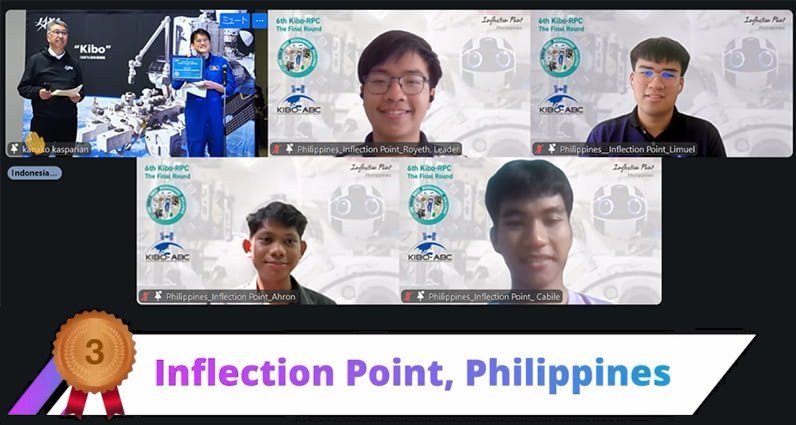
During the in-orbit finals held on Feb. 28, 2026, NASA astronaut Christopher Williams executed the programs developed by the student teams using Astrobee. The teams were evaluated based on task completion, image recognition accuracy, and mission speed.
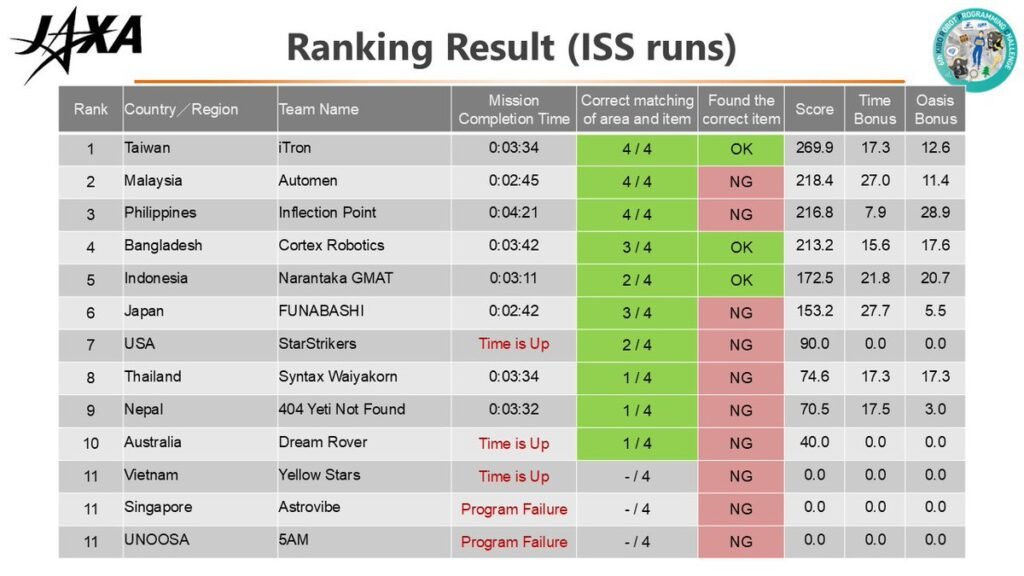
Team Inflection Point completed four out of five tasks during the live test run and earned a total score of 216.8 out of 300 points. Its performance in the “Oasis Zone,” a new feature introduced this year that offered bonus points but required teams to balance speed and strategy, helped boost its final ranking.
The Filipino team finished just 1.6 points behind Malaysia’s Team Automen, which placed second with 218.4 points. Taiwan’s Team iTron won first place with 269.9 points.
PhilSA said the latest win marks another milestone for the Philippines after Team Inflection Point’s successful debut in the Kibo-RPC in 2024, when it placed second and became the first Philippine team to join and win in the competition.
This year’s Kibo-RPC drew 738 teams from 37 countries and regions, including 25 countries under the international slot of the United Nations Office for Outer Space Affairs. Team Inflection Point earned the right to represent the Philippines after scoring the highest among 27 local applicants in the preliminary round.
Organized by the Japan Aerospace Exploration Agency in cooperation with the National Aeronautics and Space Administration, the Kibo-RPC is open to student teams in the Asia-Pacific region. The competition aims to train students in programming robots for space operations, including tasks that may support astronauts or assist during emergencies in microgravity environments.
PhilSA spearheaded the local call for applications as the country’s central government agency for space science and technology applications and as a member of the Kibo-ABC program, or Asian Beneficial Collaboration through Kibo Utilization.
The Kibo-ABC program was established under the Asia-Pacific Regional Space Agency Forum to promote the use of the Japanese Experiment Module “Kibo,” build capacity among member organizations, and support collaborative space-related projects.
The 7th Kibo-RPC is scheduled to begin in July 2026.