DATE
Loading...
TIME
Loading...
About Us
What if your empty plastic bottle could give you free internet access instead of ending up in a landfill or river?
In Catbalogan City, Samar, that idea is becoming a reality as the local government introduces a Wi-Fi vending machine that allows residents to exchange plastic bottles for minutes of internet connectivity.
Called Eco-Connect, the smart city solution turns recyclable waste into an opportunity for digital access while addressing two community concerns: plastic pollution and limited internet connectivity.
The project was officially launched during the Regional Smart Communities Exposition and Networking Engagement (rSCENE) on October 6, 2026.
Unlike conventional Wi-Fi vending machines, commonly known as piso-net, which require users to insert coins to access the internet, Eco-Connect accepts plastic bottles as payment.
For every plastic bottle deposited, users receive two minutes of internet access.
According to Catbalogan City Information and Communications Technology Officer Engr. Exequiel Cabrigas, the machine uses a Raspberry Pi processor to detect plastic materials and tin cans.
“What we’re solving here are two things. First, our environmental protection—the plastics. Because we noticed that in Antiao River, there’s a lot of plastic. Even in the parks. Then, the other part is that when you do good deeds, you throw plastics in the Eco-Connect, [then] you will have it returned [the connectivity],” Cabrigas said.
From student innovation to smart city solution
Interestingly, the technology originated from a student innovation presented during last year’s rSCENE, also hosted by Catbalogan City.
Mary Angelique Cabrigas, a senior high school student from Samar National High School, developed the Eco-Connect concept and secured third place in the Idea and Reverse Pitching Competition.
The project has since progressed into a smart city solution that the local government plans to introduce in educational institutions and public spaces.
Initial installation sites include Samar National School, Samar State University, Catbalogan Community College, Catbalogan 1 Elementary School, Catbalogan 3 Elementary School, and Imelda Public Plaza.
The initiative particularly targets students who increasingly depend on internet access for educational activities.
Under the arrangement, participating schools will supply the internet connection used by the vending machines, while the city government will collect and process the deposited plastic waste.
“Actually, we have a partnership with the schools. The schools provide the internet to the machines. It’s their social responsibility. We will collect plastic, then we will bring it to our processing plant,” Cabrigas explained.
The collected materials will be processed into usable products, including bricks and chairs, which will eventually be donated back to participating schools.
This approach creates a cycle in which discarded plastic provides temporary internet access before being repurposed into materials that benefit the same communities.
Making technology work for communities
Eco-Connect was among five smart city solutions launched during rSCENE 2026 and is already available for adoption.
Department of Science and Technology (DOST) Secretary Renato U. Solidum Jr. emphasized that smart city innovations must respond to the specific needs of communities rather than follow a uniform approach to technology development.
“There is no single template for a smart community. Whether we look at the leadership of Leyte Governor Jericho Petilla, Pasig City Mayor Vico Sotto, Quezon City Mayor Joy Belmonte, or Baguio City Mayor Benjie Magalong—their experiences teach us that we should not copy solutions blindly. We must learn, adapt, and innovate according to our local realities,” Solidum said.
The DOST chief also underscored the importance of partnerships with local government units in bringing science and technology closer to communities through the agency’s Agham na Ramdam initiative.
Meanwhile, Catbalogan City Administrator Dennis G. Cosmod said the local government aims to position the city as a destination for Meetings, Incentives, Conferences, and Exhibitions (MICE), particularly those focused on ICT innovations and smart and sustainable communities.
The rSCENE 2026 gathered innovators, students, institutions, organizations, and technology advocates to showcase science-based solutions supporting human well-being, wealth creation, wealth protection, and sustainability.
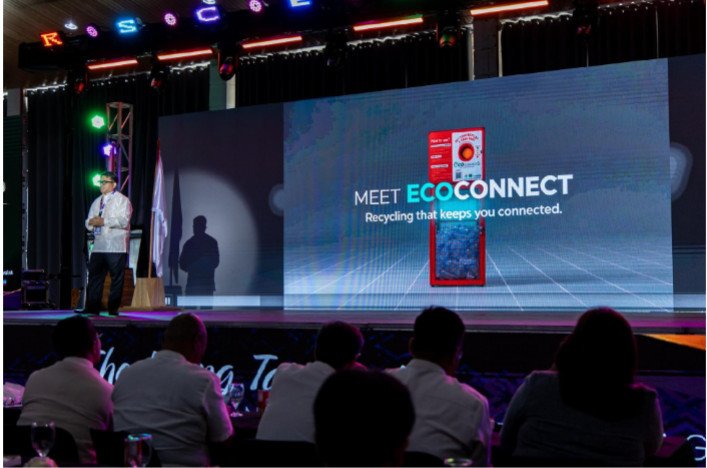
For Catbalogan City, Eco-Connect demonstrates how a relatively simple technology can address two different challenges at once.
And while the machine does not literally convert plastic into internet signals, it allows residents to trade recyclable waste for Wi-Fi access, giving discarded bottles a new purpose in an increasingly connected community.