SEC blames account holders for possible personal data leak
The Securities and Exchange Commission (SEC) has pointed to possible malware infections or unauthorized access involving account holders' devices as a potential source of a personal data leak affecting users of its digital platforms.
-
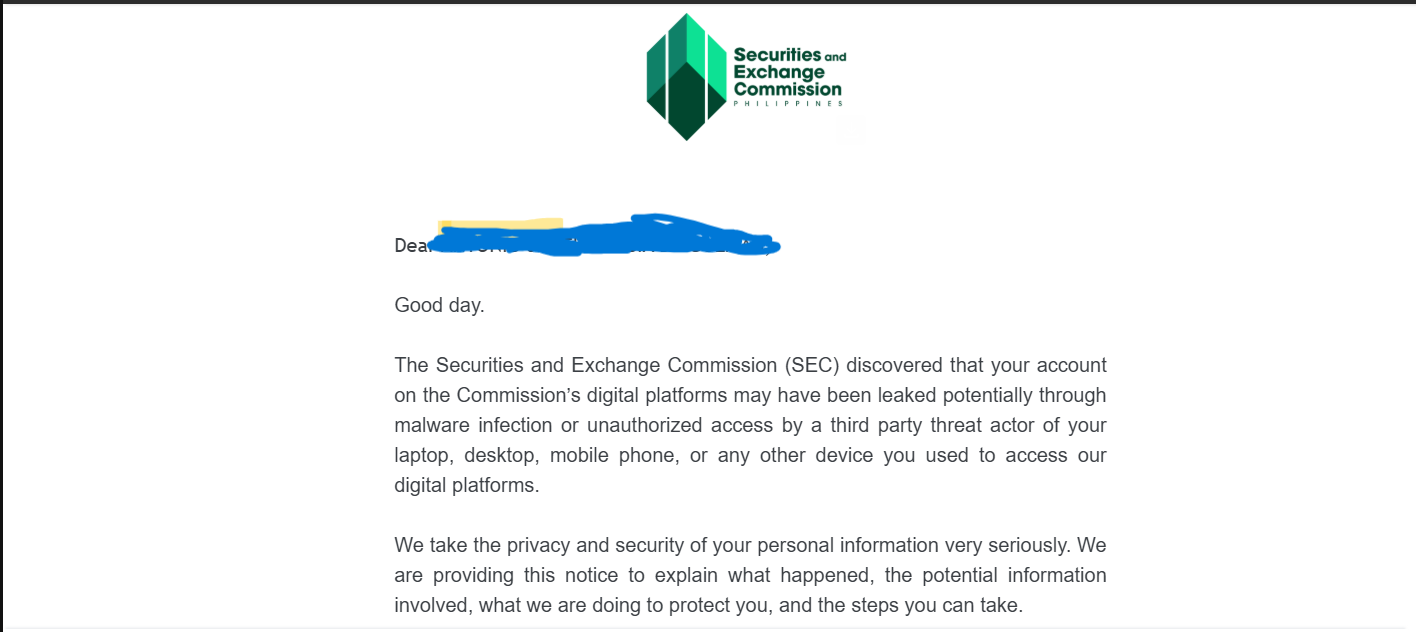
IN PHOTO: A screenshot of an email notification sent by the Securities and Exchange Commission (SEC) to account holders, citing possible malware infections or unauthorized access involving their personal devices as a potential source of data exposure.
In an email notice sent to account holders, the SEC stated:
"The Securities and Exchange Commission (SEC) discovered that your account on the Commission’s digital platforms may have been leaked potentially through malware infection or unauthorized access by a third party threat actor of your laptop, desktop, mobile phone, or any other device you used to access our digital platforms."
The commission said its digital systems remain intact and that no data was altered or modified.
Based on its initial findings, the SEC said no passwords or internal databases were leaked. However, personal information that may have been exposed includes full names, usernames, email addresses, mobile numbers, dates of birth, gender, addresses, and Tax Identification Numbers (TIN). Account holders question SEC's explanation TechWatch PH Editor-in-Tech Art Samaniego Jr., who also received the notification, criticized the SEC for suggesting that the possible data exposure originated from account holders' devices without presenting evidence. "The SEC’s notice shifted the blame to me before establishing what actually happened. I received a notification saying my account may have been leaked, potentially through malware or unauthorized access to my personal devices. Yet the notice shown provides no evidence that my laptop, desktop, or mobile phone was compromised."
Samaniego challenged the commission to substantiate its explanation and clarify whether its own systems were affected.
"If the SEC has evidence pointing to my devices, it should present it. Otherwise, suggesting that the problem originated on my end is speculation that unfairly places responsibility on the affected user. The SEC must explain what information was exposed, how it established the source of the leak, whether its own systems were affected, and what safeguards it is implementing. A statement about taking privacy seriously needs to be backed by facts, transparency, and accountability."
Meanwhile, Scam Watch Pilipinas Co-founder Jocel de Guzman, who also received the same notification, questioned the SEC's explanation in a Facebook post.
"Dear Securities and Exchange Commission Philippines, so kasalanan ko na hack kayo? Devices ko may issues ganern?" De Guzman's post included a screenshot of the SEC email highlighting the commission's statement about possible malware infections or unauthorized access involving account holders' devices.
The SEC said investigations are ongoing to determine the origin, scope, and validity of the potentially leaked dataset.
The commission also said it initiated containment and preventive measures, including security scans, strengthened access controls, additional safeguards, and monitoring of its digital infrastructure.
The National Privacy Commission (NPC) has been formally notified in accordance with mandatory reporting procedures. Account holders urged to strengthen security While the investigation continues, the SEC advised account holders to take precautionary measures to protect their personal information.
These include changing passwords, enabling two-factor or multi-factor authentication, avoiding suspicious messages, and refraining from sharing one-time passwords (OTPs).
Account holders were also encouraged to run security scans on their computers and smartphones, update antivirus software, and monitor their accounts for unusual activities.
The commission said it would continue monitoring for suspicious account activity and implementing additional verification procedures to protect personal information.
Key points
- The Securities and Exchange Commission (SEC) has pointed to possible malware infections or unauthorized access involving account holders' devices as a potential source of a personal data leak affecting users of its digital platforms.