-
Courtesy of Deep Web Konek
Days before the November 5 Million Mask March (MMM), an annual global protest associated with hacktivist collective Anonymous, a company operating one of Metro Manila's busiest railway systems has reportedly appeared on a ransomware group's list of alleged victims.
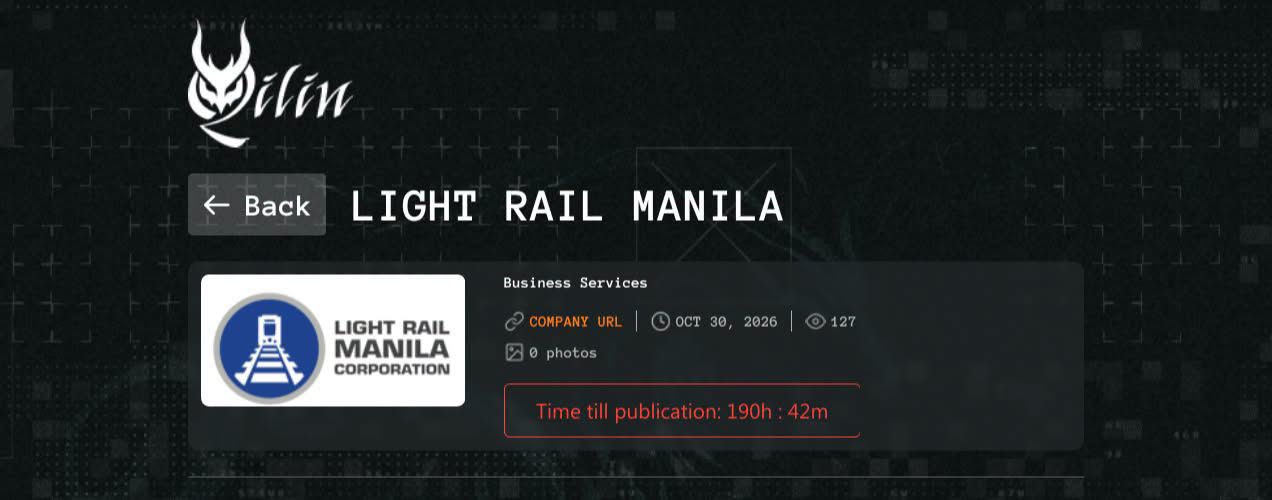
Light Rail Manila Corporation (LRMC), the private operator of Light Rail Transit Line 1 (LRT-1), has allegedly been targeted by the Qilin ransomware group after the company's name appeared on a website reportedly used by the group to identify its victims.
The Million Mask March, held annually on November 5, is a global protest associated with Anonymous and other hacktivist groups. The event is known for demonstrations against government and corporate institutions, as well as online campaigns that have sometimes involved distributed denial-of-service (DDoS) attacks aimed at disrupting websites and digital services.
However, there is no verified connection between the alleged LRMC incident and the upcoming protest.
According to cybersecurity monitoring page Deep Web Konek, a listing dated October 30, 2026, identified LRMC under the Business Services category on what appeared to be Qilin's data leak site.
The listing also displayed a countdown of approximately 190 hours and 42 minutes before the supposed publication of allegedly compromised information.
The page reportedly recorded 127 views at the time of observation and showed no uploaded photographs.
Qilin is a ransomware-as-a-service (RaaS) operation associated with cyberattacks involving data theft and double-extortion tactics.
Under this method, cybercriminals may attempt to steal sensitive information and threaten to release it publicly unless their demands are met.
Unlike distributed denial-of-service (DDoS) attacks, which attempt to overwhelm online services with traffic, ransomware attacks typically involve encrypting systems, stealing information, or threatening to expose sensitive data.
However, the nature of any potentially compromised information, the extent of the alleged intrusion, and whether any data was actually stolen remain unverified.
For LRT-1 passengers, the reported incident also raises questions about whether railway services could be affected.
There is currently no verified evidence linking the alleged ransomware activity to a compromise of train operations, signaling systems, ticketing infrastructure, or other railway control systems.
The appearance of a company's name on a ransomware leak site does not automatically mean its systems have been breached or that its operations have been disrupted.
"The incident remains under verification, pending further information from LRMC and relevant cybersecurity authorities," the report said.
"Ransomware group listings and publication countdowns should be treated as threat actor claims, not definitive proof of a successful breach or data compromise. Independent verification is necessary before establishing the scope and impact of the alleged incident," Deep Web Konek said.
As of writing, LRT-1 has yet to release an official statement regarding the alleged ransomware attack.