-
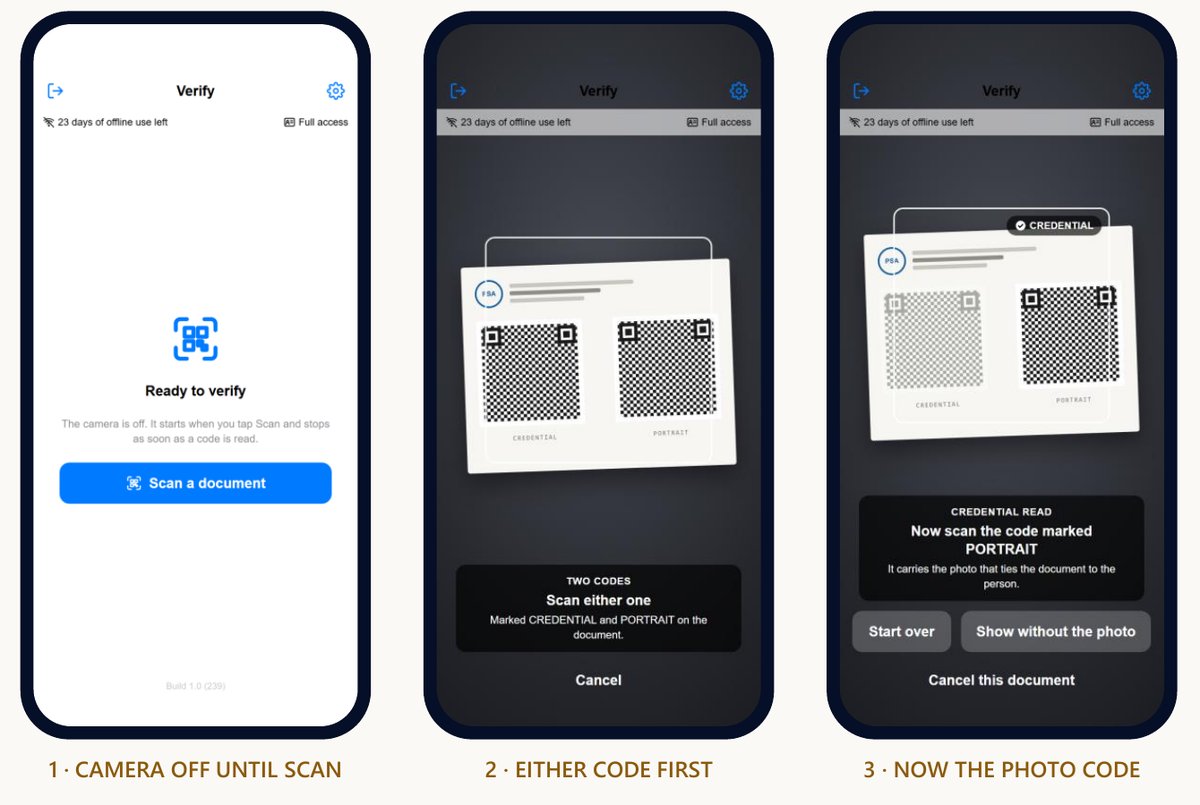
IN PHOTO: The verifier app reading a printed result with no connection. The banner shows the days of offline use remaining. Sample record.
Imagine traveling to a barangay hall or local government office to claim assistance, only to find out that your identity cannot be verified because there is no internet connection.
For Filipinos living in geographically isolated and disadvantaged areas, where mobile signals and electricity can be unreliable, this is the kind of problem a National ID verification platform developed by Ateneo de Manila University aims to address.
The Philippine Statistics Authority (PSA) is preparing to host and operate the
eKYC Extension Platform, which allows local government units (LGUs) and non-government organizations (NGOs) to verify people's identities even without an active internet connection at the point of service.
Developed by the Ateneo Business Insights Laboratory for Development (BUILD) at the John Gokongwei School of Management and its Technical Resource Lab (TRL), the platform is designed to help organizations deliver services without having to build and operate their own verification systems.
How does offline National ID verification work?
Under the system, a person first obtains a verification code from a location with internet connectivity, such as a PSA office or barangay hall.
The PSA's National ID authentication service must first confirm the person's identity before issuing an encrypted, time-limited code.
The person can then bring that code to the office providing assistance or another service, where authorized personnel can verify the information even when the location has no internet signal.
A sample printed verification result contains two codes labeled Credential and Portrait, which carry the signed identity record and photograph. These can be scanned using a verifier application without an internet connection.
Without such a system, an office facing connectivity problems may have to choose between releasing assistance without verifying the recipient's identity or delaying the service until an internet connection becomes available.
The platform is separate from the digital National ID available through the eGovPH application and does not replace the physical PhilID card.
Instead, it serves as an additional verification option while National ID card issuance and network coverage continue to expand.
“The requirement for stable internet connectivity should not be a blocker,” said Richard Lozada, Director of the Ateneo Technical Resource Lab.
“We are addressing geographically isolated and disadvantaged areas and locations with limited network and electricity. This is a mitigation strategy until National ID cards can be widely issued or an area has better network coverage.”
Making verification easier for smaller organizations
Beyond connectivity problems, another challenge involves the requirements organizations must complete before gaining access to the PSA's National ID authentication services.
As of September 25, 2026, only 150 organizations had been approved to use the PSA's eVerify service.
These approved organizations, known as relying parties, included just 28 of the Philippines' 1,634 local government units.
Among private institutions, 18 of the 67 electronic money issuers licensed by the Bangko Sentral ng Pilipinas had received approval, along with four of 38 non-bank issuers.
Several large remittance and bills payment networks were also not yet included in the approved registry.
Ateneo's experience illustrates how lengthy the process can be.
The university began its registration in April 2025, connected to the PSA's National ID authentication service on November 5, 2025, and executed its subscription agreement on April 1, 2026.
The process took 364 days and involved 13 separate requirements.
While the actual software integration took only days, much of the remaining time was spent completing documentary requirements, undergoing a third-party security assessment, and preparing a notarized contract.
Under the arrangement with the PSA, LGUs and NGOs using the PSA-hosted platform will not need to repeat Ateneo's approval process.
“A municipal government or a small NGO should not have to spend a year on documentary requirements in order to verify a person’s identity,” Lozada said. “Ateneo built the platform. The PSA will run it for them.”
PSA to take over platform operations
The eKYC Extension Platform is an initiative of Ateneo BUILD and TRL, with funding from Co-Develop as part of its work on digital public infrastructure.
Ateneo makes the software available for organizations to use, modify, and redistribute, provided they credit the university.
Under the agreement, the PSA will host and operate its own installation of the platform, while Ateneo will provide the software, a working installation, operator training, and technical support as a university contribution.
Ateneo accepted the PSA's January 2026 proposal to use the platform for its systems.
The two institutions met on October 5, 2026, to discuss transferring day-to-day management, with the goal of completing the transition by the end of the year.
A separate meeting on October 6 brought together National Statistician and Civil Registrar General Undersecretary Claire Dennis S. Mapa, Deputy National Statistician for the PhilSys Registry Office Assistant Secretary Rosalinda P. Bautista, and the Ateneo BUILD and TRL teams.
The meeting reviewed the platform and identified the next steps in support of the nationwide National ID rollout.
Can banks and financial institutions use it too?
The platform is not limited to LGUs and NGOs.
Banks, electronic money issuers, lending and financing companies, and insurance providers can also use Ateneo's software or work with the university on their own implementations.
Unlike smaller organizations that may depend on a PSA-hosted service, these institutions already operate their own systems.
They can also adopt offline verification for branch counters and payout centers where internet connectivity is unreliable.
Ateneo BUILD and TRL provide implementation assistance and training to government agencies, banks, financial institutions, and NGOs.
TRL has completed and documented the full PSA approval process, while each engagement with an interested institution is arranged separately through a service agreement with the university.
National ID verification for social protection
The initiative follows the National ID Forum: Utilizing the National ID for Social Protection Services, organized by the PSA with Ateneo BUILD and TRL in Quezon City on September 28, 2026.
The forum brought together representatives of local governments and NGOs to discuss how National ID technology could be used in delivering social protection services.
Officer-in-Charge Assistant National Statistician Atty. Henedine P. Palabras of the Use Case Development and Management Service delivered the keynote message on behalf of Assistant Secretary Bautista.
Sessions covered National ID authentication, connecting organizations to the system, social protection applications, offline National ID verification, and AI-assisted verification.
Participants in the workshop were not required to have a stable internet connection.
Ateneo TRL also demonstrated its National ID verification application during the event.
Tracking National ID adoption
Apart from developing the verification platform, Ateneo BUILD and TRL maintain a weekly record of the PSA's relying party registry, which lists organizations approved to use eVerify.
The teams believe their record is the only continuous tracking of the registry outside the PSA.
This work forms part of the Technical Resource Lab's broader digital public infrastructure initiatives.
Ateneo BUILD and Co-Develop launched the TRL Experience Center at the John Gokongwei School of Management on April 12, 2025.
The center allows students, technologists, policymakers, and entrepreneurs to explore and use digital public infrastructure services, including the Philippine Identification System.
The program has supported the development of the eKYC Extension Platform and the weekly relying party registry record.
Ateneo BUILD serves as a research and practice unit of the John Gokongwei School of Management, focusing on data, technology, and digital public infrastructure for development.
Meanwhile, the Technical Resource Lab builds and operates working systems for research, teaching, and collaboration with government agencies. TRL is approved to use the Philippine Identification System's eVerify service.
Its digital public infrastructure work is funded by Co-Develop, a global nonprofit fund supporting the adoption of safe, inclusive, and scalable digital public infrastructure.
Co-Develop aims to assist governments and local partners in at least 50 countries in building and governing core digital systems serving the public interest over the next five years. It also provides strategic support to address adoption challenges and contributes research on the role of digital public infrastructure in development.