Binance, St. Luke’s Incidents Expose Cybersecurity Risks Beyond the Firewall
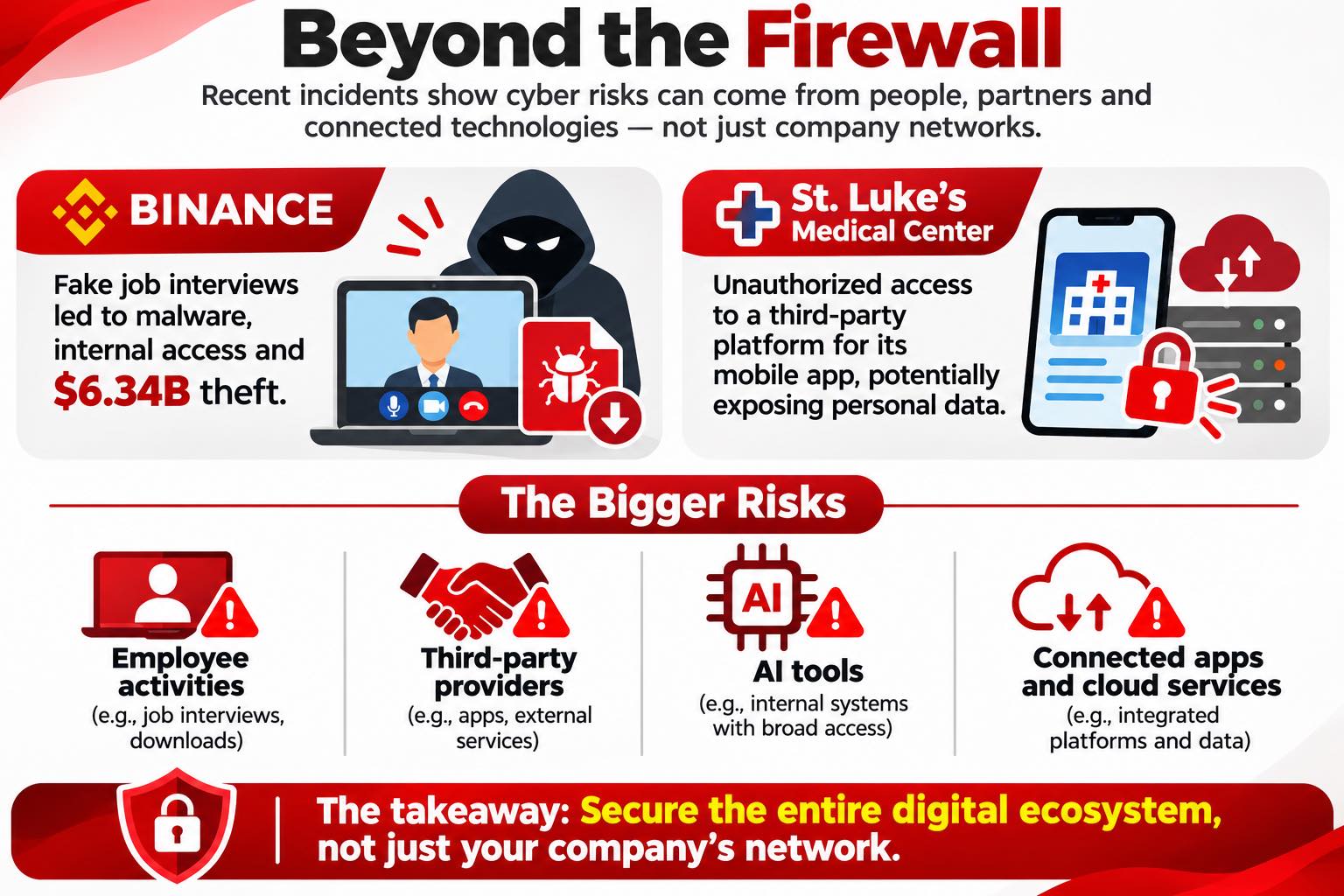
At Binance, hackers used fake online job interviews to trick a software engineer into downloading malware. The attack eventually compromised internal systems, including an AI tool, and led to the theft of $6.34 billion in digital assets
-
TechWatch PH
Recent incidents involving cryptocurrency exchange Binance and St. Luke’s Medical Center show how attackers can exploit trusted connections beyond traditional security defenses.
At Binance, hackers used fake online job interviews to trick a software engineer into downloading malware. The attack eventually compromised internal systems, including an AI tool, and led to the theft of $6.34 billion in digital assets. READ: North Korea-linked hackers blamed for record $6.3B Binance theft “It was not a single isolated breach or a simple phishing incident,” Binance said in its November 3 incident report. In the Philippines, St. Luke’s disclosed unauthorized access to a third-party platform supporting its mobile application, potentially affecting personal information of patients and employees. READ: NPC confirms St. Luke’s data breach notification following unauthorized access to third-party platform
The hospital said its electronic medical records and core clinical systems were unaffected. The National Privacy Commission is reviewing the incident, with responsibility for the breach yet to be established.
Both cases point to a growing challenge for organizations: securing systems and activities beyond their direct control.
Firewalls, antivirus software and access controls remain essential. But these measures alone cannot eliminate risks introduced by employees, external technology providers and interconnected applications.
The increasing use of AI, cloud services and third-party platforms also expands the number of potential entry points for attackers.
For Philippine companies, particularly banks, hospitals, telecommunications firms and government agencies, cybersecurity must now include closer scrutiny of service providers, employee activities and access privileges across connected systems.
It also raises questions about accountability when customer information is exposed through external platforms.
The challenge is no longer just keeping hackers out of corporate networks. It is securing the entire digital ecosystem on which organizations increasingly depend.
A company may have secured its network, but its weakest link could already be operating outside it.
Key points
- At Binance, hackers used fake online job interviews to trick a software engineer into downloading malware. The attack eventually compromised internal systems, including an AI tool, and led to the theft of $6.34 billion in digital assets